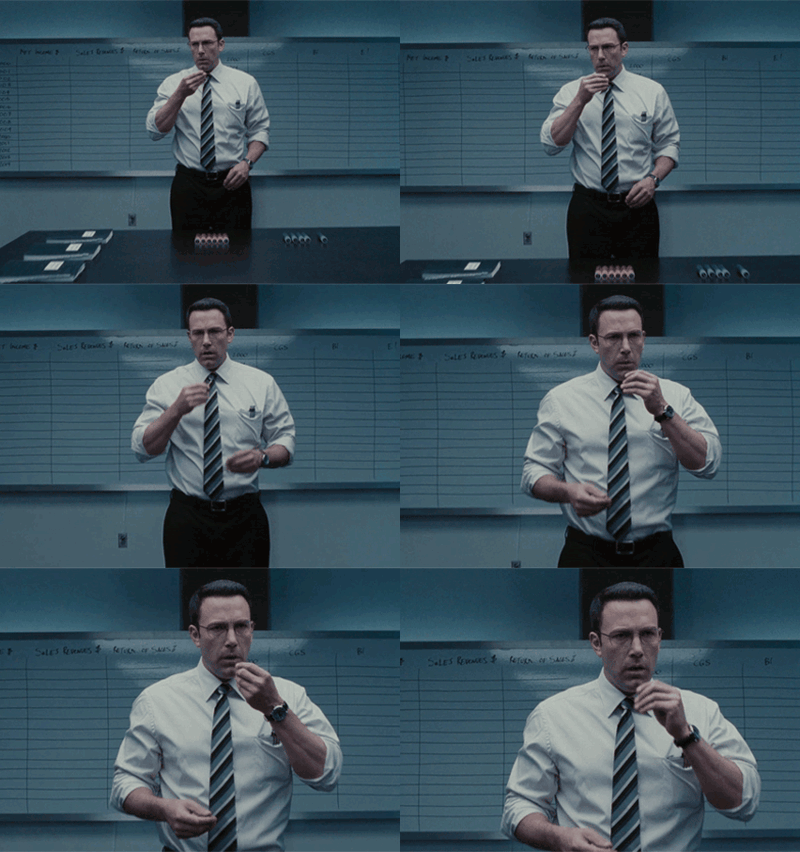
"THE ACCOUNTANT" (2016) ReviewI have seen some unusual crime dramas in my life. Most of these films or television programs usually revolved around odd narrative structures, characters in unusual situations or characters with eccentric ticks. And I have also seen the occasional film about autistic characters. But for the likes of me, I cannot recall seeing a crime drama of any form in which the main character is autistic . . . until I saw the recent film, "THE ACCOUNTANT".Written by Bill Dubuque and directed by Gavin O'Connor, "THE ACCOUNTANT" told the story of Christian Wolff, a mental calculator who works as a forensic accountant at ZZZ Accounting in Plainfield, Illinois. Christian also tracks insider financial deceptions for numerous criminal enterprises. His services are brokered to him by a "Voice on his phone", from a restricted number. Christian had been diagnosed with a high-functioning form of autism and offered an opportunity to live at Harbor Neuroscience Institute in New Hampshire. However, his Army officer father thought otherwise and decided Christian learn to overcome his autism via extensive training in martial arts and sharpshooting. This decision drove Christian's mother to leave his family, which included a younger brother.The story begins with "The Voice" giving Christian a new assignment - auditing state-of-the-art robotics corporation Living Robotics, whose in-house accountant, Dana Cummings, has found suspicious financial discrepancies. The company's CEO and his sister, Lamar Blackburn, and his sister, associate Rita Blackburn, willingly cooperate with Christian's investigation; but CFO Ed Chilton dismisses Dana's findings as a mistake. When Christian - with minor help from Dana - eventually discover the embezzlement of $61 million dollars from the company, a hitman named Braxton forces the diabetic Chilton to self-administer a fatal insulin overdose by threatening to kill both him and his wife brutally in the manner of a home invasion. The Blackburns later surmises that Chilton was the embezzler and close the investigation, leaving Christian distraught as he has not completed his study. However, the embezzler decides that both Christian and Dana still poses a major threat and instructs Braxton and his men to kill the pair. At the same time, Christian's past activities have attracted the attention of Raymond King, the director of FinCEN in the Treasury Department, who recruits a young data analyst named Marybeth Medina into helping him identify and arrest Christian. He does this via blackmail by threatening to expose her undeclared criminal past if she refuses.Judging from the above mentioned plot, one would surmise that "THE ACCOUNTANT" has a complicated plot. I would not say that. I would not label Dubuque's screenplay as simplistic or unoriginal. But I must admit that the embezzlement plot was not exactly a brain teaser for me. It did not take me very long to figure out the identity of the embezzler and Braxton's client. More importantly, Christian's final encounter with the embezzler ended on a . . . well, anti-climatic note for me. Let me rephrase this. That final encounter started out rather exciting, due to Christian's fights with Braxton and his men, who found themselves serving as the embezzler's bodyguard. But the manner in which that entire action scene ended struck me as anti-climatic and rather disappointing.Despite its ending, I must admit that I found most of "THE ACCOUNTANT" rather enjoyable. The creme of the movie proved to be its deep exploration of the Christian Wolff character struck me as very interesting - especially the flashbacks featuring his childhood and the tragic circumstances that led to his father's death. The story delved into his problems with overcoming his autism, his father's refusal to consent professional counseling for his, and his struggles to interact with others. The movie also explored Christian's few successes in forming relationships with a small handful of people that include his younger brother; the mute daughter of the Harbor Neuroscience Institute's director named Justine; an accountant he had met during a brief stint in prison named Francis Silverberg; an Illinois farm couple that allowed him to practice his sharpshooting on his property; and Dana Cummings. I was also taken by surprised by Christian's connection to FinCEN Agent King and the latter's reason for coercing Agent Medina to investigate the case. Perhaps this is why "THE ACCOUNTANT" worked better as a character study/crime drama . . . without the mystery of the embezzler's identity attached to it."THE ACCOUNTANT" featured some solid performances from the supporting cast that included John Lithgow, Jean Smart, Jeffrey Tambor, Andy Umberger, Alison Wright, Robert C. Treveiler, Ron Prather and Susan Williams. But I especially enjoyed Jon Bernthal's performance as the ruthless, yet sardonic hit man, Braxton. I also enjoyed Cynthia Addai-Robinson's portrayal as the blackmailed Agent Marybeth Medina, whose fear of being exposed gradually crumbled away due to a desire to pursue justice. J.K. Simmons gave an interesting performance as Agent Ray King, whose ruthless pursuit of Christian proved to be unusually emotional. Anna Kendrick gave a rather charming performance as accountant Dana Cummings, whose original response to Christian seemed to be one of bewilderment. As the two become close, both Kendrick and Ben Affleck developed a charming, sibling-like chemistry on-screen.Speaking of Affleck, I thought he gave one of the most interesting performances of his career, so far. I realize that many critics and moviegoers tend to overlook Affleck's acting skills - something that I never understood - but I thought he really knocked it out of the ballpark portraying a character who was not only a highly skilled ex-military type, but also someone who is both a mental calculator and is autistic. Hollywood has featured a lead who is autistic (1988's "RAIN MAN") and even a young autistic boy who had witnessed a murder (1998's "MERCURY RISING"). But a leading man in an action film? The character of Christian Wolff and Ben Affleck's performance was something quite new to me.Yes, I will admit that I was a little disappointed by the mystery surrounding the movie's embezzling plot. I was also a bit disappointed by how the movie's final action sequence ended. I found it a bit too anti-climatic. But I really enjoyed the rest of the movie, especially its portrayal of the main character, Christian Wolff. I thought director Gavin O'Connor handled both an interesting story created by screenwriter Bill Dubuque and an excellent cast, led by the talented Ben Affleck, in what I believe might be one of his most interesting roles.

I wrote this commentary on the seventh episode of "THE PACIFIC":
"THE PACIFIC" (2010) Episode Seven "Peleliu III" Commentary
In Episode Seven, "THE PACIFIC" finally ended its three-part focus on the Battle of Peleliu. This particular one centered on Eugene Sledge (Joseph Mazzello) and his experiences with the 5th Marines regiment in the hills of Peleliu Island in October 1944.
The episode began with a montage featuring Sledge and the 5th Marines battling it out against the Japanese Army for a period of time – a first for the miniseries – until their return to the airfield for a brief respite. There, Sledge has a conversation with his company commander, Captain Andrew “Ack Ack” Haldane (Scott Gibson). As the 5th Marines prepare to head back into the hills, Sledge spotted Colonel Chesty Puller (William Sadler) and the 1st Marines regiment heading back toward the beach. One of that regiment’s wounded turned out to be one Lou "Chuckler" Juergens (Josh Helman), barely conscious, while smoking a cigarette.
As Sledge and the 5th Marines returned to the hills, the episode gave viewers another peek into John Basilone’s (Jon Seda) continuing publicity tour as a war hero. Only this time, the novelty has finally worn off. The war bond drive and celebrity status has driven Basilone into his own personal hell. He also seemed to be haunted by memories of Guadalcanal and the death of Manny Rodriguez (Jon Bernthal). This brief glimpse of Basilone’s dissatisfaction will eventually lead to his decision to request a return to active duty.
But most of the episode featured Sledge and the 5th Marines’ continuing experiences on Peleliu. The horrors that the Mobile native had experienced during the landing and the battle across the airfield almost seemed like child’s play in comparison to his experiences in the Peleliu hills. I say . . . almost. What Sledge and the others had experienced during Episode Five and Episode Sixseemed pretty hellish to me. In this episode, Sledge, his fellow Marines and the Japanese soldiers all seemed, at times, to be experiencing the lowest forms of humanity. And Episode Seven provided it all with brutal combat scenes, gruesome deaths and worst of all, mutilation of bodies – dead or alive.
Earlier in the episode, Sledge had looked upon some of his fellow Marines’ mutilation of dead Japanese soldiers with disgust. One particular Marine even tried to remove the gold teeth from a Japanese soldier, who was badly wounded but still alive. Sledge expressed his disgust aloud, demanding that the enemy soldier be put out of his misery. Later in the episode, he sang a different tune after his company suffered major losses in the command structure. First, a wounded Lieutenant Edward “Hillbilly” Jones (Leon Ford) was killed by stray bullets, while being carried from the battlefield by stretcher bearers. Not much time had passed before Corporal R. V. Burgin (Martin McCann) announced Captain Haldane’s death from a sniper to his platoon. Following Haldane’s death, Sledge finally had an urge to engage in a little mutilation of Japanese soldiers on his own. Fortunately, “Snafu” Shelton (Rami Malek) managed to talk him out of committing an act he would have eventually regretted. The episode ended with the 5th Marines returning to Parvuvu. However, Sledge returned as someone different from the inexperienced Marine that had a reunion with his childhood friend, some four months ago. This was especially apparent in his reaction to the sight of nurses greeting returning Marines on Parvuvu. Perhaps in his mind, they seemed like an illusion amidst the realities of war.
Many fans seemed to view Episode Seven as the best in the entire miniseries, so far. Perhaps. Perhaps not. Some also believe that it is the series’ most depressing episode. At the moment, I believe that Episode Four still holds that honor. But I do believe thatEpisode Seven was the most brutal in the series so far – with both Episode Two and Episode Six tying for second place. Director Tim Van Patten did an exceptional job in conveying the brutality and chaos of war in the Pacific Theater. Two scenes that really drove home the fact to me were the surprising death of Hillbilly Jones, which took me completely by surprise; and the image of “Snafu” Shelton tossing pebbles into the head of a dead Japanese soldier. By the time Sledge and his fellow Marines had returned to Parvuvu, I felt as if I had experienced the combat version of hell and beyond. However, I do have two quibbles about the episode.
In real life, a Navy corpsman named Doc Caswell had been the one to convince Sledge not to mutilate a dead Japanese soldier. In the miniseries, it was “Snafu”. My problem with this particular scene stemmed from another in last week’s episode, in which “Snafu” had supported Sledge’s pragmatic reaction to Hillbilly's order for someone to shut up a wailing Marine with a deadly whack on the head. I found it difficult to view that “Snafu” as the same man who stopped Sledge from mutilating a dead Japanese soldier. And I feel that Captain Haldane’s death lacked any real drama. Do not get me wrong. Haldane was probably an excellent leader and a good Marine. But Scott Gibson’s portrayal of the officer made him seem like a 2.0 version of the Richard Winters character in ”BAND OF BROTHER”. I also found it difficult to experience any surge of emotion over his death, considering that it had occurred off-screen. If screenwriter Bruce McKenna could change history and allow “Snafu” to convince Sledge not to commit any mutilation, then surely he could have allowed the Alabamian to witness Haldane’s death.
The episode did feature some superb performances – especially by Joseph Mazzello and Rami Melek. And while I had a slight problem with the idea of “Snafu” convincing Sledge not to mutilate that Japanese soldier, I must admit that this scene has led me to believe that the two actors had given the best performances in the entire episode. But I also feel that Martin McCann did a fine job in developing Burgin into a top-notch squad leader. When I first saw Gary Sweet’s portrayal of Gunnery Sergeant Elmo Haney back inSeason Five, I thought it was a bit too exaggerated and something of a joke. But I must admit that not only did he managed to grow on me, I found his portrayal of Haney’s growing sense of despair over the bloodbath on Peleliu very impressive. But I cannot forget Jon Seda's brief, yet memorable performance as war hero John Basilone. With a minimum of words and a great deal of facial expressions and body language, he did a superb job of conveying Basilone's despair over being trapped into some kind of celebrity hell. He has grown a great deal as an actor.
Episode Seven capped what I believe to be the best part of "THE PACIFIC" - a three-part glimpse into the brutality of the controversial battle, Peleliu. I suspect that many viewers might find this surprising. Because so many combatants had died on the beaches and in the caves of Peleliu, the island now has a war memorial honoring the dead of both the Americans and the Japanese.
Next, John Basilone is transferred to the Fifth Marine Division and experiences combat on Iwo Jima.
"THE PACIFIC" (2010) EPISODE TWO "Guadalcanal II" Commentary
Episode Two of HBO’s ”THE PACIFIC” continued the saga of the U.S. Marines during the Guadalcanal campaign.Episode One focused mainly on Robert Leckie’s combat experiences during the campaign. This latest episode centered on the combat experiences of Sergeant John Basilone and his fellow comrades from the 7th Marines regiment.
By the time I had finished watching Episode Two, I found myself battling a tension headache. And it was all due to action sequences featured in this episode. Granted, I also found the battle scenes in Episode One rather tense, the action in this second episode knocked it out of the ballpark for me. Around late October 1942, John Basilone and a handful of his fellow Marines were forced to fight off a frontal assault by the Japanese Army. Between the assault and Basilone’s encounters with Japanese troops, while fetching more ammunition literally had me squirming on my living room sofa. And I must say that Jon Seda did a great job of portraying Basilone’s heroics and making it look natural in the process. I also have to give kudos to actor Joshua Biton for his emotional portrayal of one of Basilone’s close friends, J.P. Morgan.
With the exception of an aerial bombing sequence, this particular episode did not feature Leckie and his friends in actual combat. Instead, the episode focused upon them dealing with various other problems during their stay on Guadalcanal – lack of supplies, inadequate arms and . . . um, health issues. Poor Runner dealt with an attack of the runs and Leckie found himself throwing up after consuming stolen canned peaches on a half-empty stomach. Leckie and a good number of other Marines stole supplies left on the beach for the arriving U.S. Army. In a hilarious scene, Leckie managed to pinch the peaches, along with cans of other food; and a pair of moccasins and a box of cigars that belonged to an Army officer. I never knew that actor James Badge Dale had a talent for comic timing . . . until now.
Episode Two also revealed a glimpse of Eugene Sledge back in Mobile. He and his father, Dr. Sledge, have discovered that Sledge’s heart murmur no longer exists. Upon this discovery, Sledge wasted no time in announcing his intention to join the Marines. And viewers will eventually see the results of that decision by Episode Five.
By the end of the episode, the Marines were ordered to leave the island, much to the relief of many. Both Basilone and Morgan found themselves trying to rationalize the death of their friend, Manny Rodriguez, while other Marines loaded up in boats taking them off the island. A scene that featured good, solid acting by both Seda and Biton. The episode’s last scene featured Leckie and his friends learning from a Navy cook aboard ship that their actions on Guadalcanal had been reported in American newspapers and that they were now all regarded as heroes. Judging from the expressions on the Marines’ faces, they seemed conflicted on how to accept the news. This wonderfully performed scene by Badge Dale and the actors portraying Leckie's friends - Josh Helman (Chuckler), Keith Nobbs (Runner) and Jacob Pitts (Hoosier)- was mentioned in Leckie’s memoirs.
Like Episode One, this was a well done that left me feeling tense and an array of other emotions. I only hope that the miniseries’ remaining episodes will match the quality of the first two.
 "THE PACIFIC" (2010) EPISODE ONE "Guadalcanal I" Commentary
Nearly five years ago saw the premiere of the ten-part miniseries, "THE PACIFIC"; which was produced by Tom Hanks, Steven Spielberg and Gary Goetzman.
The miniseries focuses upon the lives and experiences of three U.S. Marines who had fought in the Pacific Theater - writer Robert Leckie (James Badge Dale), war hero John Basilone (Jon Seda) and professor/writer Eugene Sledge (Joseph Mazzello).
This first episode featured the three men's reaction to the attack upon Pearl Harbor in December 1941. Basilone is already a one-year veteran of the Marines around this time, as he says good-bye to his family. Leckie joins the Marines about a month after the Hawaii attack and forms a friendship with a local girl named Vera before saying good-bye to his father. And Sledge is forced to realize that his heart murmur will prevent him from joining the Marines with his friend and neighbor, Sid Phillips (Ashton Holmes). Not long after this opening, both Leckie and Basilone find themselves being shipped out to deal with the Japanese threat on Guadalcanal. Most of the episode focuses upon Leckie and Phillips' early experiences on Guadalcanal. By the end of the episode, Basilone and the 7th Marines Regiment have arrived.
If there is one thing I can say, "THE PACIFIC" is definitely different from 2001's "BAND OF BROTHERS". But I guess I expected it to be. One thing, this episode made it clear that there will be scenes featuring the three characters' experiences on the home front and among other civilians. That scene between Leckie saying good-bye to his father at the bus depot was very interesting - especially with the writer dealing with his father's reluctance to say good-bye. And it was interesting to watch Sledge deal with his frustration at being unable to join up, due to his heart murmur. I found myself wondering if he had any idea what he would experience during the war's later years, would he be so frustrated.
The main difference between "THE PACIFIC" and "BAND OF BROTHERS" is that the latter was mainly a retelling of the experience of an Army company, with an officer as the series' main character. I think that "THE PACIFIC" is being presented in a way that is similar to the 2000 movie, "TRAFFIC" or the 2005 movie, "CRASH" . . . in which the same topic is presented from different perspectives. In this case, the miniseries is from the viewpoints of three men who DID NOT serve in combat together. And yet, there are connections between them. Leckie served in the same Marine company as Sledge's best friend, Phillips. Both Leckie and Basilone fought on Guadalcanal and have a brief encounter with one another at the end of Episode One. And later, we will see both Leckie and Sledge fight in another campaign together - Peleliu. I only hope that many people will understand and learn to accept the fact that "THE PACIFIC" had a different style of storytelling than "BAND OF BROTHERS".
By the way, I want to say a few last things. I must say that the action in this episode was amazing, along with the jungle setting. And the birthday tune that Leckie and the other Marines sang to Phillips was not only funny, but had an ominous aura as well. Well done. Well done.
"THE PACIFIC" (2010) EPISODE ONE "Guadalcanal I" Commentary
Nearly five years ago saw the premiere of the ten-part miniseries, "THE PACIFIC"; which was produced by Tom Hanks, Steven Spielberg and Gary Goetzman.
The miniseries focuses upon the lives and experiences of three U.S. Marines who had fought in the Pacific Theater - writer Robert Leckie (James Badge Dale), war hero John Basilone (Jon Seda) and professor/writer Eugene Sledge (Joseph Mazzello).
This first episode featured the three men's reaction to the attack upon Pearl Harbor in December 1941. Basilone is already a one-year veteran of the Marines around this time, as he says good-bye to his family. Leckie joins the Marines about a month after the Hawaii attack and forms a friendship with a local girl named Vera before saying good-bye to his father. And Sledge is forced to realize that his heart murmur will prevent him from joining the Marines with his friend and neighbor, Sid Phillips (Ashton Holmes). Not long after this opening, both Leckie and Basilone find themselves being shipped out to deal with the Japanese threat on Guadalcanal. Most of the episode focuses upon Leckie and Phillips' early experiences on Guadalcanal. By the end of the episode, Basilone and the 7th Marines Regiment have arrived.
If there is one thing I can say, "THE PACIFIC" is definitely different from 2001's "BAND OF BROTHERS". But I guess I expected it to be. One thing, this episode made it clear that there will be scenes featuring the three characters' experiences on the home front and among other civilians. That scene between Leckie saying good-bye to his father at the bus depot was very interesting - especially with the writer dealing with his father's reluctance to say good-bye. And it was interesting to watch Sledge deal with his frustration at being unable to join up, due to his heart murmur. I found myself wondering if he had any idea what he would experience during the war's later years, would he be so frustrated.
The main difference between "THE PACIFIC" and "BAND OF BROTHERS" is that the latter was mainly a retelling of the experience of an Army company, with an officer as the series' main character. I think that "THE PACIFIC" is being presented in a way that is similar to the 2000 movie, "TRAFFIC" or the 2005 movie, "CRASH" . . . in which the same topic is presented from different perspectives. In this case, the miniseries is from the viewpoints of three men who DID NOT serve in combat together. And yet, there are connections between them. Leckie served in the same Marine company as Sledge's best friend, Phillips. Both Leckie and Basilone fought on Guadalcanal and have a brief encounter with one another at the end of Episode One. And later, we will see both Leckie and Sledge fight in another campaign together - Peleliu. I only hope that many people will understand and learn to accept the fact that "THE PACIFIC" had a different style of storytelling than "BAND OF BROTHERS".
By the way, I want to say a few last things. I must say that the action in this episode was amazing, along with the jungle setting. And the birthday tune that Leckie and the other Marines sang to Phillips was not only funny, but had an ominous aura as well. Well done. Well done.