Showing posts with label paul giamatti. Show all posts

Wednesday, October 13, 2021

"DUPLICITY" (2009) Photo Gallery


Below are images from the 2009 comedy, "DUPLICITY". Written and directed by Tony Gilroy, the movie starred Julia Roberts and Clive Owen:


"DUPLICITY" (2009) Photo Gallery

duplicity16


duplicity18


duplicity-rivals


image6


Duplicity (2009)


kinopoisk.ru-Duplicity-887906


kinopoisk.ru-Duplicity-904203


kinopoisk.ru-Duplicity-1393027


Screenshot_image2-Duplicity-2009


Monday, April 1, 2019

"SAVING MR. BANKS" (2013) Review

image


“SAVING MR. BANKS” (2013) Review

When I first saw the trailer for the recent biopic, “SAVING MR. BANKS”, I knew I would like it. First of all, the movie was about the development of one of my favorite movies of all time, the 1964 musical “MARY POPPINS”. And two, it featured some very humorous moments that I personally found appealing. Not long after the movie first hit the theaters, I rushed to see it as soon as I possibly could. 

Directed by John Lee Hancock, “SAVING MR. BANKS” told the story of “Mary Poppins” author P.L. Travers’ two-week stay in 1961 Los Angeles, while filmmaker Walt Disney attempts to obtain from her, the official screen rights to her novels. The development of “SAVING MR. BANKS” began when Australian filmmaker Ian Collie produced a documentary on Travers back in 2002. He saw a potential biopic and convinced Essential Media and Entertainment to develop a feature film with Sue Smith as screenwriter. The project attracted the attention of producer Alison Owen, who subsequently hired Kelly Marcel to co-write the screenplay with Smith. Marcel removed a subplot involving Travers and her son, and divided the story into a two-part narrative - the creative conflict between Travers and Disney, and her dealings with her childhood issues. Because Marcel’s version featured certain intellectual property rights that belonged to the he Walt Disney Company, Owen approached Corky Hale, who informed former Disney composer, Richard M. Sherman of the script. Sherman supported Marcel’s script. Meanwhile, the Disney Studios learned of the script, as well. Instead of purchasing the script in order to shut down the production, they agree to co-produce the movie, allowing Kelly Marcel access to more material regarding the production of “MARY POPPINS”. The Disney Studios approached Tom Hanks for the role of Walt Disney, who accepted. When they failed to secure Meryl Streep for the role of P.L. Travers, they turned to Emma Thompson, who accepted it.

Through the urging of her literary agent, a financially struggling P.L. Travers finally decides to leave her London home, and agreed to meet and negotiate with Walt Disney in Los Angeles over the film rights to her “Mary Poppins” stories, after twenty years. While in Los Angeles, Travers express disgust over what she regards as the city’s unreality and the naivety and overbearing friendliness of its inhabitants like her assigned limousine driver, Ralph. At the Disney Studios in Burbank, Travers collaborates with the creative team assigned to develop the movie - screenwriter/artist
Don DaGradi, Richard and Robert Sherman. She finds their casual manner and their handling of the adaptation of her novels distasteful. And Travers is also put off by Disney’s jocular and familiar personality. She pretty much remains unfriendly toward her new acquaintances and a new set of problems arise between her and the studio. Her collaboration with the Disney Studios also reveals painful memories of her childhood in 1906-07 Australia and memories of her charismatic father, Travers Goff, who was losing a battle against alcoholism; and her mother Margaret Goff, who nearly committed suicide, due to her inability to control Goff’s heaving drinking.

Hollywood politics can be mind-boggling. I learned this valuable lessons, following the reactions to not only the recent historical drama, “THE BUTLER”, but also the reactions to “SAVING MR. BANKS”. The first movie came under fire by conservatives for its historical inaccuracies, when President Ronald Reagan’s son accused that movie of a false portrait of his father. Some four-and-a-half months later, many feminists accused the Disney Studios of not only damaging P.L. Travers’ reputation, but also of historical inaccuracies. Actress Meryl Streep, who had been an earlier candidate for the role of Travers, added her two cents by openly accused Walt Disney of being a bigot on so many levels, while presenting an acting award to Emma Thompson. Since political scandal brought “SAVING MR. BANKS” under heavy criticism for historical accuracy or lack of, I figure I might as well discuss the matter.

Was the movie historically accurate in its portrayal of P.L. Travers? Many criticized the movie’s failure to delve into the author’s bisexuality and relationship with her adopted son. What they failed to realize was that Travers’ sex life and adopted son had nothing to do with her creation of “Mary Poppins” or her dealings with Disney. The movie they wanted was the movie written by Sue Smith. And Alison Owen had put the kibbosh on those storylines long before the Disney Studios got involved. Disney did meet with Travers at her London home. Only he did so in 1959, not 1961. But the movie was accurate about him gaining the movie rights after her 1961 visit. Disney’s 1959 London trip only resulted in his acquiring an option - which gave the filmmaker a certain period of time to acquire the actual film rights. However, Travers’ family, the Goffs, moved to Allora, Queensland in 1905, not 1906 as the movie had suggested.

Was Travers that difficult, as suggested in the movie? I honestly have no idea. Richard Sherman made it clear that he found her difficult to like. I have read somewhere that Travers had managed to alienate both her adopted son and her grandchildren by the time of her death in 1996. And there are also … the audio tapes that recaptured Travers’ sessions with Don Di Gradi and the Sherman Brothers in 1961. Tapes that she had requested. She did not come off well in those tapes. Critics also claimed that the movie idealized Disney. Here, I have to keep myself from laughing. Granted, the movie and actor Tom Hanks portrayed the “Disney charm” at its extreme. But the movie made it clear that Disney was utilizing his charm to convince Travers to sign over the movie rights. And quite frankly, his charm came off as somewhat overbearing and manipulative in some scenes. I perfectly understood Travers’ reaction to the sight of Disney stuffed animals, balloons and fruit baskets in her hotel room. And I certainly sympathize with her reaction to being dragged to Disneyland against her will. I have loved the theme park since I was a kid. But if I had been in Travers’ shoes, I would have been pissed at being dragged to some location against my will.

When the movie first flashed back to Travers’ Australian childhood, I had to suppress an annoyed sigh. I really was not interested in her childhood, despite what the movie’s title had indicated. But the more the movie delved into her childhood and made the connections to her creation of the “Mary Poppins” and the development of the 1964 movie, the more I realized that Kelly Marcel had written a brilliant screenplay. By paying close attention to the story during my second viewing of the movie, I noticed the connections between the tragic circumstances of Travers’ childhood, “Mary Poppins” and her 1961 Los Angeles visit. Some of the connections I made were the following:

*Travers’ aversion of Southern California weather, which must have reminded her of Australia and her childhood

*Her aversion to pears, which reminded her of Travers Goff’s death

*Her aversion to a Mr. Banks with facial hairs

*Her aversion to Mr. Banks’ cinematic personality

*Her aversion to the color red, which may have also reminded her of Mr. Goff’s death

*Her reaction to the Sherman Brothers’ song - “Fidelity Fiduciary Bank”, which brought back painful memories of an incident regarding her father at a local fair

*Her Aunt Ellie, whom she re-created as Mary Poppins


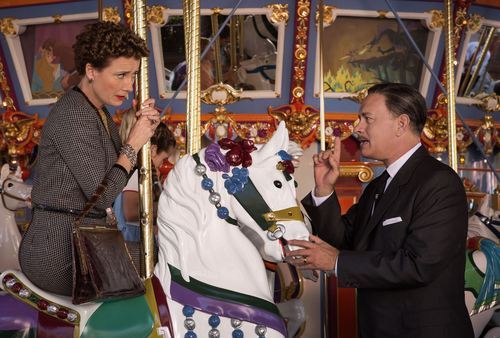
I also have to compliment the movie’s visual re-creation of both 1961 Southern California and Edwardian Queensland, Australia. Production designer Michael Corenblith had to re-create both periods in Travers’ life. And if I must be honest, he did an exceptional job - especially in the 1961 scenes. His work was ably supported by Lauren Polizzi’s colorful art direction, and Susan Benjamin’s set decorations. I also enjoyed Daniel Orlandi’s elegant and subtle costumes for the movie. I was amazed by his re-creation of both Edwardian and mid-20th century fashion, as seen in the images below:

mrbanks_image

bilde

I found John Schwartzman’s photography very interesting … especially in the 1961 sequences. Unlike other productions that tend to re-create past Los Angeles in another part of the country (2011's “MILDRED PIERCE”), “SAVING MR. BANKS” was shot entirely in Southern California. But what I found interesting about Schwartzman’s photography is that he utilized a good deal of close-up in those exterior scenes for Beverly Hills and Burbank in an effort to hide the changes that had occurred in the past 50 years. Mark Livolsi’s editing did a solid job in enabling Schwartzman to hide the changes of time for the Southern California exteriors. But I also have to commend Livolsi for his superb editing of one particular sequences - namely the juxtaposition of the 1961 scene featuring the Sherman Brothers’ performance of the “Fidelity Fiduciary Bank” song and the 1906 scene of the bank-sponsored fair in Allora. Thanks to Livolsi’s editing, John Lee Hancock’s excellent direction and Colin Farrell’s portrayal of Travers Goff, this sequence proved to be the most mind-blowing and unforgettable in the entire movie.

Since I had mentioned Colin Farrell, I might as well discuss the cast’s performances. Emma Thompson won the National Board of Review award for Best Actress for her superb portrayal of the very complex P.L. Travers. She did a superb job in portraying the very complex author. One would think Tom Hanks had an easier job in his portrayal of filmmaker Walt Disney. Superficially, I would agree. But Hanks did an excellent job in conveying some of the more annoying aspects of Disney’s character behind the charm - especially in his attempts to win over Travers. Colin Farrell gave one of the best performances of his career as Travers’ charming, yet alcoholic father, Travers Goff. I was especially impressed by his performance in the Allora Fair scene. Bradley Whitford was cast as Disney Studios animator/screenwriter Don DaGradi. He not did a first-rate job in portraying DaGradi’s enthusiasm as a Disney employee, but also in portraying how that enthusiasm nearly waned under the weight of Travers’ negative reactions to the project. Both Jason Schwartzman and B.J. Novak were cast as the songwriting brothers - Richard and Robert Sherman. And they both did excellent jobs in capturing the pair’s contrasting personalities. Schwartzman was deliciously all pep and enthusiasm as the extroverted and younger Richard. Novak struck me as very effective in his portrayal of the more introverted and intense Robert. Ruth Wilson managed to give a very memorable performance as Travers’ long-suffering mother, Margaret Goff. She was especially impressive in one tense scene that featured Mrs. Goff’s suicide attempt. And Paul Giamatti was simply marvelous as Travers’ fictional limousine driver, Ralph. He managed to be both sweet and charming, without being saccharine. The movie also featured solid performances from Annie Rose Buckley, Kathy Baker, Melanie Paxson, Rachel Griffiths and Ronan Vibert.

I must admit that for several years, I had felt angry and frustrated over how “SAVING MR. BANKS” was deprived from any Academy Award nominations, aside from one for Thomas Newman’s score. And if I must be brutally honest, I did not find his score particularly memorable. I was more impressed by John Lee Hancock’s direction, the movie’s visual styles, the performances from a superb cast led by Emma Thompson and Tom Hanks; and especially the Kelly Marcel and Sue Smith screenplay. And considering how so much talent was overlooked by the Academy of Motion Pictures and Arts, I do not think I can take Hollywood’s politics seriously anymore. But I believe there is no doubt that this superb film was a victim of political extremism.

Sunday, January 27, 2019

"SAVING MR. BANKS" (2013) Photo Gallery

01

Below are images from "SAVING MR. BANKS", the recent historical comedy-drama about the development of the 1964 film, "MARY POPPINS". Directed by John Lee Hancock, the movie stars Emma Thompson and Tom Hanks: 


"SAVING MR. BANKS" (2013) Photo Gallery

kinopoisk.ru-Saving-Mr-Banks-2285546


banks


kinopoisk.ru-Saving-Mr-Banks-2236901


kinopoisk.ru-Saving-Mr-Banks-2236902


n-BJ-NOVAK-large570


kinopoisk.ru-Saving-Mr-Banks-2265063


kinopoisk.ru-Saving-Mr-Banks-2265064


kinopoisk.ru-Saving-Mr-Banks-2285547


kinopoisk.ru-Saving-Mr-Banks-2285548


kinopoisk.ru-Saving-Mr-Banks-2285549


kinopoisk.ru-Saving-Mr-Banks-2285550


kinopoisk.ru-Saving-Mr-Banks-2285551


kinopoisk.ru-Saving-Mr-Banks-2285552


kinopoisk.ru-Saving-Mr-Banks-2285553


kinopoisk.ru-Saving-Mr-Banks-2285554


kinopoisk.ru-Saving-Mr-Banks-2285555


bj-novak-saving-mr-banks


kinopoisk.ru-Saving-Mr-Banks-2285556


kinopoisk.ru-Saving-Mr-Banks-2285558


kinopoisk.ru-Saving-Mr-Banks-2285559


kinopoisk.ru-Saving-Mr-Banks-2285868


kinopoisk.ru-Saving-Mr-Banks-2285869


kinopoisk.ru-Saving-Mr-Banks-2285870


kinopoisk.ru-Saving-Mr-Banks-2296994


saving-mr-banks-movie-review


tom-hanks-as-walt-disney-in-saving-mr-banks-first-look-03

Thursday, February 1, 2018

"12 YEARS A SLAVE" (2013) Review

twelve-years-a-slave08


"12 YEARS A SLAVE" (2013) Review

I first learned about Solomon Northup many years ago, when I came across a television adaptation of his story in my local video story. One glance at the video case for "HALF-SLAVE, HALF-FREE: SOLOMON NORTHUP'S ODYSSEY" made me assume that this movie was basically a fictional tale. But when I read the movie's description on the back of the case, I discovered that I had stumbled across an adaption about a historical figure. 

Intrigued by the idea of a free black man in antebellum America being kidnapped into slavery, I rented "HALF-SLAVE, HALF-FREE: SOLOMON NORTHUP'S ODYSSEY", which starred Avery Brooks, and enjoyed it very much. In fact, I fell in love with Gordon Park's adaption so much that I tried to buy a video copy of the movie. But I could not find it. Many years passed before I was able to purchase a DVD copy. And despite the passage of time, I still remained impressed by the movie. However, I had no idea that someone in the film industry would be interested in Northup's tale again. So, I was very surprised to learn of a new adaptation with Brad Pitt as one of the film's producer and Briton Steve McQueen as another producer and the film's director.

Based upon Northup's 1853 memoirs of the same title, "12 YEARS A SLAVE" told the story of a New York-born African-American named Solomon Northup, who found himself kidnapped and sold into slavery in 1841. Northup was a 33 year-old carpenter and violinist living in Saratoga Springs, New York with his wife and children. After Mrs. Northup leaves Saratoga Springs with their children for a job that would last for several weeks, Northup is approached by two men, who offered him a brief, high-paying job as a musician with their traveling circus. Without bothering to inform Northup traveled with the strangers as far as south as Washington, D.C. Not long after his arrival in the capital, Northup found himself drugged and later, bound in the cell of a slave pen. When Northup tried to claim he was a free man, he was beaten and warned never again to mention his free status again.

Eventually, Northup and a group of other slaves were conveyed to the slave marts of New Orleans, Louisiana and given the identity of a Georgia-born slave named "Platt". There, a slave dealer named Theophilus Freeman sells him to a plantation owner/minister named William Ford. The latter's kindness seemed to be offset by his unwillingness to acknowledge the sorrow another slave named Eliza over her separation from her children. When Northup has a violent clash with one of Ford's white employees, a carpenter named John Tibeats, the planter is forced to sell the Northerner to another planter named Edwin Epps. Unfortunately for Northup, Epps proves to be a brutal and hard man. Even worse, Epps becomes sexually interested in a female slave named Patsey. She eventually becomes a victim of Epps' sexual abuse and Mrs. Epps' jealousy. And Epps becomes aware of Patsey's friendship with Northup.

"TWELVE YEARS A SLAVE" has gained a great deal of critical acclaim since its release. It is already considered a front-runner for the Academy Awards. Many critics and film goers consider it the truest portrait of American slavery ever shown in a Hollywood film. I have to admit that both director Steve McQueen and screenwriter John Ridley have created a powerful film. Both did an excellent job of translating the basic gist of Solomon Northup's experiences to the screen. And both did an excellent job re-creating a major aspect of American slavery. I was especially impressed by certain scenes that featured the emotional and physical trauma that Northup experienced during his twelve years as a Southern slave. 

For me, one of the most powerful scenes featured Northup's initial experiences at the Washington D.C. slave pen, where one of the owners resorted to physical abuse to coerce him into acknowledging his new identity as "Platt". Other powerful scenes include the slave mart sequence in New Orleans, where fellow slave Eliza had to endure the loss of her children through sale. I found the revelation of Eliza's mixed blood daughter being sold to a New Orleans bordello rather troubling and heartbreaking. Northup's encounter with Tibeats struck me fascinating . . . in a dark way. But the film's most powerful scene - at least for me - proved to be the harsh whipping that Patsey endured for leaving the plantation to borrow soap from a neighboring plantation. Some people complained that particular scene bordered on "torture porn". I disagree. I found it brutal and frank.

I have to give kudos to the movie's visual re-creation of the country's Antebellum Period. As in any well made movie, this was achieved by a group of talented people. Adam Stockhausen's production designs impressed me a great deal, especially in scenes featuring Saratoga Springs of the 1840s, the Washington D.C. sequences, the New Orleans slave marts and of course, the three plantations where Northup worked during his twelve years in Louisiana. In fact, the entire movie was filmed in Louisiana, including the Saratoga Springs and Washington D.C. sequences. And Sean Bobbitt's photography perfectly captured the lush beauty and color of the state. Trust the movie's producers and McQueen to hire long time costume designer, Patricia Norris, to design the film's costumes. She did an excellent job in re-creating the fashions worn during the period between 1841 and 1852-53.

Most importantly, the movie benefited from a talented cast that included Garrett Dillahunt as a white field hand who betrays Northup's attempt to contact friends in New York; Paul Giamatti as the New Orleans slave dealer Theophilus Freeman; Michael K. Williams as fellow slave Robert, who tried to protect Eliza from a lustful sailor during the voyage to Louisiana; Alfre Woodward as Mistress Shaw, the black common-law wife of a local planter; and Bryan Blatt as Judge Turner, a sugar planter to whom Northup was loaned out. More impressive performances came from Paul Dano as the young carpenter John Tibeats, who resented Northup's talent as a carpenter; Sarah Poulson, who portrayed Edwin Epp's cold wife and jealous wife; and Adepero Oduye, who was effectively emotional as the slave mother Eliza, who lost her children at Freeman's slave mart. Benedict Cumberbatch gave a complex portrayal of Northup's first owner, the somewhat kindly William Ford. However, I must point out that the written portryal of the character may have been erroneous, considering Northup's opinion of the man. Northup never judged Ford as a hypocrite, but only a a good man who was negatively influenced by the slave society. But the two best performances, in my opinion, came from Lupita Nyong'o and especially Chiwetel Ejiofor. Nyong'o gave a beautiful performance as the abused slave woman Patsey, whose endurance of Epps' lust and Mrs. Epps' wrath takes her to a breaking point of suicidal desire. Chiwetel Ejiofor, whom I have been aware for the past decade, gave the definitive performance of his career - so far - as the New Yorker Solomon Northup, who finds himself trapped in the nightmarish situation of American slavery. Ejiofor did an excellent job of conveying Northup's emotional roller coaster experiences of disbelief, fear, desperation and gradual despair.

But is "12 YEARS A SLAVE" perfect? No. Trust me, it has its flaws. Many have commented on the film's historical accuracy in regard to American slavery and Northup's twelve years in Louisiana. First of all, both McQueen and Ridley took historical liberty with some of Northup's slavery experience for the sake of drama. If I must be honest, that does not bother me. The 1984 movie with Avery Brooks did the same. I dare anyone to find a historical movie that is completely accurate about its topic. But what did bother me was some of the inaccuracies featured in the movie's portrayal of antebellum America. 

One scene featured Northup eating in a Washington D.C. hotel dining room with his two kidnapper. A black man eating in the dining room of a fashionable Washington D.C. hotel in 1841? Were McQueen and Ridley kidding? The first integrated Washington D.C. hotel opened in 1871, thirty years later. Even more ludicrous was a scene featuring a drugged and ill Northup inside one of the hotel's room near white patrons. Because he was black, Northup was forced to sleep in a room in the back of the hotel. The death of the slave Robert at the hands of a sailor bent on raping Eliza struck me as ludicrous. One, it never happened. And two, there is no way some mere sailor - regardless of his color - could casually kill a slave owned by another. Especially a slave headed for the slave marts. He would find himself in serious financial trouble. Even Tibeats was warned by Ford's overseer about the financial danger he would face upon killing Northup. I can only assume that Epps was a very hands on planter, because I was surprised by the numerous scenes featuring him supervising the field slaves. And I have never heard of this before. And I am still shaking my head at the scene featuring Northup's visit to the Shaw plantation, where he found a loaned out Patsey having refreshments with the plantation mistress, Harriet Shaw. Black or white, I simply find it difficult to surmise a plantation mistress having refreshments with a slave - owned or loaned out. Speaking of Patsey's social visit to the Shaw plantation, could someone explain why she and Mistress Shaw are eating a dessert that had been created in France, during the late 19th century? Check out the image below:

128a_df-03580small_wide-879620131931ee255e493bfe53f31a385ed0b2b5-s6-c30

The image features the two women eating macarons. Now I realize that macarons had existed even before the 1840s. But the macarons featured in the image above (with a sweet paste creating a sandwich with two cookies) first made their debut, thanks to a pair of Parisian bakers in the late 19th century, decades after the movie's setting. This was a very sloppy move either on the part of Stockhausen or the movie's set decorator, Alice Baker.

And if I must be frank, I had a problem with some of the movie's dialogue. I realize that McQueen and Ridley were attempting to recapture the dialogue of 19th century America. But there were times I felt they had failed spectacularly. Some of it brought back painful memories of the stilted dialogue from the 2003 Civil War movie, "GODS AND GENERALS". The words coming out of the actors' mouths struck me as part dialogue, part speeches. The only thing missing was a speech from a Shakespearean play. 

Not only did I have a problem with the dialogue, but also some of the performances. Even those performances I had earlier praised nearly got off tracked by the movie's more questionable dialogue. But I was not impressed by two particular performances. One came from Brad Pitt, who portrayed a Canadian carpenter hired by Epps to build a gazebo. To be fair, my main problems with Pitt's performance was the dialogue that sounded like a speech . . . and his accent. Do Canadians actually sound like that? In fact, I find it difficult to pinpoint what kind of accent he actually used. The performance that I really found troubling was Michael Fassbender's portrayal of the brutal Edwin Epps. Mind you, he had his moments of subtle acting that really impressed me - especially in scenes featuring Epps' clashes with his wife or the more subtle attempts of intimidation of Northup. Those moments reminded me why I had been a fan of the actor for years. But Fassbender's Epps mainly came off as a one-dimensional villain with very little subtlety or complexity. Consider the image below in which Fassbender is trying to convey Epps' casual brutality:

665806_300

For me, it seemed as if the actor is trying just a little too hard. And I suspect that McQueen's direction is to blame for this. I blame both McQueen and Ridley for their failure to reveal Epps' insecurities, which were not only apparent in Northup's memoirs, but also in the 1984 movie. Speaking of McQueen, there were times when I found his direction heavy-handed. This was especially apparent in most of Fassbender's scenes and in sequences in which some of the other characters' dialogue spiraled into speeches. And then there was Hans Zimmer's score. I have been a fan of Zimmer for nearly two decades. But I have to say that I did not particularly care for his work in "12 YEARS A SLAVE". His use of horns in the score struck me as somewhat over-the-top.

Do I feel that "12 YEARS A SLAVE" deserves its acclaim? Well . . . yes. Despite its flaws, it is a very good movie that did not whitewash Solomon Northup's brutal experiences as a slave. And it also featured some exceptional performances, especially from Chiwetel Ejiofor and Lupita Nyong'o. But I also feel that some of the acclaim that the movie has garnered, may have been undeserved. As good as it was, I found it hard to accept that "12 YEARS A SLAVE" was the best movie about American slavery ever made.

Tuesday, January 2, 2018

"12 YEARS A SLAVE" (2013) Photo Gallery

kinopoisk.ru-12-Years-a-Slave-2265072

Below are images from the historical drama, "12 YEARS A SLAVE". Based upon Solomon Northup's 1853 autobiography, ""Twelve Years a Slave" and directed by Steve McQueen, the movie stars Chiwetel Ejiofor: 


"12 YEARS A SLAVE" (2013) Photo Gallery

12-Years-A-Slave


12-Years-a-Slave-13


12-Years-a-Slave-Chiwetel-Ejiofor


12-years-a-slave-movie-poster-5


12-Years-A-Slave-Paulson-Nyongo_t620x620_c620x620


article-2424697-1BB2629C000005DC-746_634x445


Benedict_Cumberbatch__Chiwetel_Ejiofor_and_Michael_Fassbender_star_in_12_Years_a_Slave___trailer


tumblr_inline_mtt1aqL1ki1r4gc4k


128a_df-03580small_wide-879620131931ee255e493bfe53f31a385ed0b2b5-s6-c30


brad-pitt-12-years-a-slave


Chiwetel-Ejiofor-12-Years-A-Slave


kinopoisk.ru-12-Years-a-Slave-2258053


kinopoisk.ru-12-Years-a-Slave-2265074


maxresdefault


NP_ENT_091613_480x360


QuvenzhaneFL12yearsSlavefull5001


rs_560x415-131016142906-1024.12-years-slave-ls-101613


Twelve-Years-a-Slave


twelve-years-a-slave01


twelve-years-a-slave07


twelve-years-a-slave08


twelve-years-a-slave09


twelve-years-a-slave10


Twelve-Years-a-Slave-1024x424


twelve-years-a-slave-img01


twelve-years-a-slave-img02