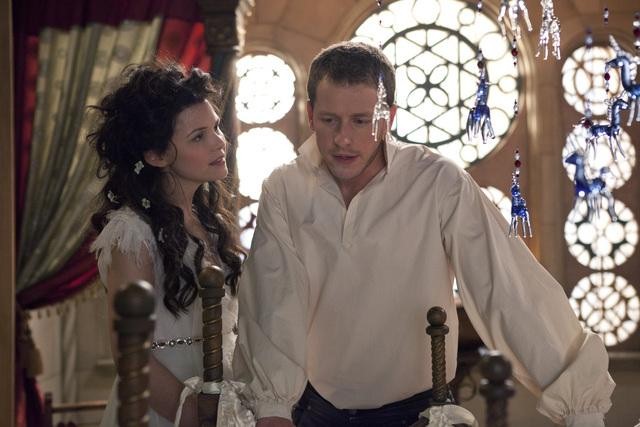
Below are images from Season One of ABC's "ONCE UPON A TIME".The series stars Jennifer Morrison, Ginnifer Goodwin, Josh Dallas, Lana Parrilla and Robert Carlyle:
"ONCE UPON A TIME" Season One (2011-2012) Photo Gallery
There have been seven versions of A.E.W. Mason’s 1902 novel, "The Four Feathers". At least three of them were silent films. In 1939, British producer Alexander Korda released the first sound adaptation of the novel. This version was also the first one to be filmed in color. Directed by Korda’s brother, Zoltan Korda, "THE FOUR FEATHERS" starred John Clements, June Duprez, Ralph Richardson and C. Aubrey Smith.
Not only was this version of "THE FOUR FEATHERS" the first to feature both sound and color, it is regarded by many as the best adaptation of Mason’s novel. Fifteen years has passed since I last saw this movie. When I first saw it back in the mid-1990s, I was very impressed by this film. After seeing it fifteen years later (or more), I am still impressed. Somewhat. Granted, my admiration for the movie has dimmed slightly, but I still believe that it is a first-class movie.
Unlike Mason’s novel or the recent 2002 version, this version of "THE FOUR FEATHERS" is not set right after General Charles Gordon’s death in 1885. Instead, the movie is set in 1895. Harry Faversham is an officer in the British Army and his regiment has been ordered to the Sudan to avenge the death of Charles "Chinese" Gordon from ten years ago. On the eve of its departure, British officer Harry Faversham (Clements) resigns his commission. As a result, his three friends and fellow officers, Captain John Durrance (Richardson) and Lieutenants Burroughs (Donald Grey) and Willoughby (Jack Allen), express their contempt of his supposed cowardice by each sending him a white feather attached to a calling card. When his fiancée, Ethne Burroughs (Duprez), says nothing in his defense, he bitterly demands one more from her. She refuses, but he plucks one from her fan and leaves. While the officers go off to war, he admits to his old acquaintance Dr. Sutton (Frederick Culley) that he is a coward and must make amends. He departs for Egypt. There, he adopts the disguise of a native with the help of Dr. Harraz (Henry Oscar), choosing to play a despised mute Sangali to hide his lack of knowledge of the language.
What can I saw about "THE FOUR FEATHERS"? For one, it is a beautiful looking film. I understand that it had been filmed in both Great Britain and in Sudan. And photographers Georges Périnal and Osmond Borradaile did a beautiful job in capturing the scope and color (via Technicolor) of both countries. It was not surprising for me to learn that the film had received an Academy Award nomination for Best Cinematography. I also found Miklos Rozsa’s score, Vincent Korda’s uncredited production design, W. Percy Day’s matte paintings, along with Godfrey Brennan and René Hubert’s costume designs impressive, as well.
But I am merely procrastinating. I have not discussed the meat of the movie – namely the story and the acting. Well, I might as well start with the first. R.C. Sherriff, Lajos Biro and Arthur Wimperis created a solid adaptation of Mason’s novel. They made a few changes. As I had stated before, they set the movie in the 1890s, enabling them to incorporate the British victory at the Battle of Omdurman in September 1898 into the plot. The novel was set around the mid 1880s. The character of Abou Fatma (featured in both the novel and in other versions, including the 2002 movie) is not this film. But these changes did not hurt the plot. "THE FOUR FEATHERS" still turned out to be a rousing action-adventure film. When I first saw the movie back in the early 1990s, the patriotic jingoism surrounding the British Empire did not bother me at all. Fifteen years later, it did. Somewhat. I have seen plenty of old films from the 1930s and 1940s that painted the British Empire in a positive light. Unfortunately, this version of "THE FOUR FEATHERS" did so at a level that sometimes came off as a little too heavy-handed for my taste. I suspect that the reason behind the three screenwriters’ decision to set the movie in the mid-to-late 1890s in order to allow the movie to feature an actual British imperialist victory – Omdurman - and a chance to wave the flag. The movie did question the idea of what constituted bravery or cowardice. But once Harry arrived in the Sudan, the topic never reared its ugly head again. Hmmm. Too bad.
The movie featured a solid, first-rate cast. John Clements gave an excellent performance as Harry Faversham, who is emotionally torn between his aversion to the idea of serving as a British officer and continuing his family’s military tradition. My only quibble with his performance was that I found his . . . 'portrayal' of a mute Sangali exaggerated. The other first-rate performance featured in this movie came from Ralph Richardson, who portrayed Faversham’s best friend and romantic rival, Jack Durrance. I was especially impressed by how Richardson conveyed Jack’s desperation to hide his blindness from his command and his hopeless infatuation with Harry’s fiancée, Ethne Burroughs. Who, by the way, was portrayed by June Duprez. Ms. Duprez gave a charming performance. But aside from two scenes – one that featured her discovery of Harry’s resignation from the Army and her regret for pushing him away – Miss Duprez’s Ethne seemed to lack depth. Well known British character actor, C. Aubrey Smith gave a sprightly and funny performance as Ethne’s father, the irascible General Burroughs who continues to live in the past glories of his service during the Crimean War. In fact, the movie’s running joke turned out to be the General’s embellishments of his favorite war story – the Battle of Balaclava.
When one comes down to it, the 1939 version of "THE FOUR FEATHERS" is a rousing and entertaining tale about a disgraced British Army officer who finds redemption through his private heroic acts to protect his former colleagues and friends during the last year of the Mahdist War. My main quibble with the movie centered around the script written by R.C. Sherriff, Lajos Biro and Arthur Wimperis. Granted, they did a first-rate job of adapting Mason’s novel. But aside from the first third of the movie in which the script briefly questioned society’s idea of bravery, the story seemed lack depth and in the end, came off as a propaganda film for the British Empire. However, Georges Périnal and Osmond Borradaile’s Technicolor photography of both England and the Sudan are absolutely breathtaking and deserving of an Oscar nomination. The movie featured a solid cast that included excellent performances by John Clements and Ralph Richardson. And Zoltan Korda kept it all together with his skillful direction that featured some excellent dramatic moments and great action.
I realize that many consider Korda’s version of "THE FOUR FEATHERS" to be the best of the seven already made. This is an opinion that I cannot honestly share. It is also an opinion I have not harbored in the past decade. It is a little too jingoistic for my taste. And aside from the Harry Faversham and Jack Durrance characters, most of the other characters do not strike me as possessing enough depth. But it is a first-rate action-adventure film. And it is easy to see why so many fans still love it after seventy-five years.
I wrote this article about one of the major characters in the "NORTH AND SOUTH" Trilogy, written by John Jakes and adapted for television by David Wolper:
"REMEMBERING VIRGILIA HAZARD"
My recent viewing of my "NORTH AND SOUTH Trilogy" DVD set, led me to the "Special Feaures" section that featured a behind-the-scene look at the television miniseries trilogy. In it, Patrick Swayze (Orry Main), James Read (George Hazard), Lesley Anne-Down (Madeline Fabray) producer David Wolper and the trilogy's author, John Jakes discussed both the literary and television versions of the saga. I found their recollections of the trilogy's production very interesting and entertaining. But the actors' admissions that they regarded abolitionist Virgilia Hazard to be their favorite character took me by surprise. Even more surprising was my discovery that John Jakes shared similiar feelings.
In the saga, Virgilia Hazard (Kirstie Alley) was the only daughter of iron manufacturer William Hazard (John Anderson) and his wife, Maude (Inga Swenson) in Lehigh Station, Pennsylvania. She had three brothers - the eldest sibling Stanley (Jonathan Frakes), the youngest Billy (John Stockwell/Parker Stevenson) and middle brother George. Unlike most of her family, Virgilia became a firm devotee of causes for women's rights, civil rights for free Northern blacks and especially the abolitionist cause in mid-19th century United States. In fact, one could honestly say that Virgilia's devotion to abolition eventually drifted into fanaticism.
Virgilia ended up being one of the most complex characters that author Jakes had ever created. On one hand, her fanaticism, tactless behavior, self-righteousness and bigotry toward all Southern-born whites made her a very unpleasant person. Just how unpleasant could Virgilia be? She had a tendency to air her beliefs to anyone within hearing range, regardless of whether they wanted to listen to her or not. She became so blind and bigoted in her self-righteousness toward Southern whites - especially those from the planter-class - that she failed to notice that despite her brother George's close friendship with South Carolinian Orry Main, he had also become a devoted abolitionist and civil rights advocate by the eve of the Civil War. If she had been willing to open herself more to the Mains, she would have discovered another potential abolitionist in their midst - namely Orry's younger cousin Charles.
Her tactless behavior nearly cost George's friendship with Orry, when she helped Grady (Georg Sandford Brown), the slave of the Mains' neighbor, James Huntoon (Jim Metzler), escape from slavery during the Hazards' visit to South Carolina. That same tactless behavior led her to take part in John Brown's 1859 raid on Harper's Ferry and expose herself needlessly to the local militia. And because of this, Grady - who had become her husband - rushed forward to save her ended up dead, instead. Virgilia's worst act - at least to me - was her decision to toss away her convictions and self-esteem to become Congressman Sam Greene's (David Odgen Stiers) mistress, following her confrontation with a hospital administrator (Olivia DeHavilland) over a Confederate officer's accidental death. In order to avoid being arrested for murder. She had no problem with confronting her family and neighbors' scorn over her devotion to abolition. She had no problem with confronting the Mains in her complicity to help Grady escape. But when she faced a murder investigation, she threw her self-esteem to wind and lowered herself to the level of a prostitue in order to stay out of prison.
But for all of her faults, Virgilia also possessed a great deal of virtues. Why else would the likes of Swayze and Read declare that she was their favorite character? One cannot help but admire her resilient devotion to the abolitionist cause, which was not very popular with most of her family and fellow Northerners. She was open-minded enough to look past Grady's skin color and view him as an attractive man, worthy for her hand in marriage. Many, including most of the Hazards, had dismissed her marriage to Grady as a political statement. Only one member of the Hazard family suspected the truth - George's Irish-born wife, Constance Flynn Hazard (Wendy Kilbourne).
And while many "NORTH AND SOUTH" fans may have abhorred Virgilia's habit of speaking her mind, I cannot help but admired it. If I must be honest, I almost envy her willingness to do so. I really enjoyed Virgilia's confrontations with her family and the Main family about slavery and reminders of the institution's horrors. I believe it took a lot of guts on her part and I admire her for this. Virgilia's practice of "telling it like it is" seemed very apparent in three scenes:
*Philadelphia Abolitionist Meeting - in which she gave a speech about the practices of slave breeding on Southern plantations. Despite Orry's outraged reaction to her speech, it turns out that Virgilia had spoken the truth. Due to the United States' official banning of the Atlantic Slave Trade in 1808, many Southern planters were forced to resort to the deliberate breeding of their female slaves to either maintain the number of slaves in the South or to make a fortune in selling such slaves when the value of their land depleted.
*Opposition to the Mexican-American War - during Orry's first meeting with the Hazard family, Virgilia made her disgust and opposition to the United States' threat to wage war against Mexico very clear, claiming that many of the war's supporters saw it as an opportunity to conquer Mexican territory and use it for the expansion of slavery. I hate to say this, but slavery's expansion had been a strong reason for those who supported the idea of war.
*Confrontation Over Grady's Escape - this is without a doubt, my favorite scene in which Virgilia confronted her family and the Mains over her disgust with slavery. Hell, I had practically cheered the woman as she made it clear that not only the South, but the entire country will eventually pay a price for its complicity in the institution of slavery. And she had been right.
It took a brave woman to willingly pursue a cause that many found unpopular . . . and make her convictions to others, quite clear. Hell, I think that she had more balls than all of the men in her family. Even more so, she did not hide her beliefs and convictions behind a personable veneer in order to soothe the sociabilities of her family and their friends.
I also discovered that both Lesley Anne Down (Madeline Fabray) and David Carridine (Justin LaMotte) had received Golden Globe nominations for their performances in the first miniseries. Frankly, I find this appalling for I believe that Kirstie had deserved a nomination, as well. Probably even more so, considering that she had a more difficult role. I wonder if both any of the other cast members felt the same.
Below are photos from "ROBIN HOOD", director Ridley Scott's 2010 adaptation of the English folklore hero. Russell Crowe, Cate Blanchett and Mark Strong star:

.jpg)