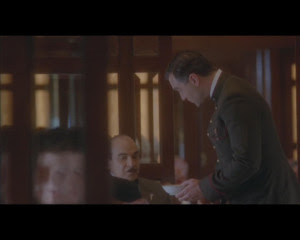
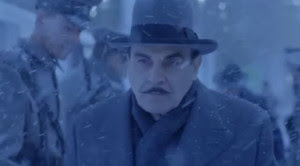
Below is my review of the 2010 adaptation of one of Agatha Christie's 1934 novel, "MURDER ON THE ORIENT EXPRESS": "MURDER ON THE ORIENT EXPRESS" (2010) ReviewAfter being on the air for two decades, "Agatha Christie’s POIROT" decided to air its own version of the mystery writer’s 1934 novel, "Murder on the Orient Express". Although there have been two other well known adaptations of the novel – the famous 1974 movie that starred Albert Finney and the 2001 teleplay that starred Alfred Molina. But this latest version starred David Suchet (considered by many to be the ultimate Hercule Poirot) in the starring role.Directed by Philip Martin and written by Stewart Harcourt, "MURDER ON THE ORIENT EXPRESS" opened with Hercule berating a British Army officer, who has been revealed to be a liar in regard to a case. Upon completion of said case, Poirto travels over to Istanbul, the first step of his journey back to England. There, Poirot witnesses the stoning of a Turkish woman for adultery with a Colonel Arbuthnot and a Miss Mary Debenham. Thanks to an old acquaintance named Monsieur Bouc, a director of the Compagnie Internationale des Wagons-Lits (which owned the Orient Express lines), the detective manages to book passage aboard the famed continental train, the Orient Express. Among the passengers are Colonel Arbuthnot, Miss Debenham and a sinister American businessman named Samuel Rachett. The latter tries to hire Poirot’s services to protect him from unseen enemies; but the detective refuses due to a dislike toward the American. After the Orient Express becomes caught in a snowdrift in the middle of Yugoslavia, Rachett is found murdered in his compartment – stabbed to death twelve times. As it turned out, Poirot discovered that Rachett was a criminal named Casetti, who was guilty of kidnapping and murdering one Daisy Armstrong, the five year-old daughter of a wealthy Anglo-American couple. To protect the passengers from the Yugoslavia police, Monsieur Bouc hires Poirot to investigate the American’s murder.Considering this film turned out to be the third, well-known adaptation of Christie’s novel, there were bound to be comparisons with the previous films – especially the famous 1974 version. All three movies featured changes from the novel. In this adaptation, screenwriter Stewart Harcourt decided to allow Poirot to witness the stoning of an adulterous Turkish woman. The characters of Doctor Constantine (a Greek doctor who volunteered to assist Poirot) and an American private detective named Cyrus Hardman were combined into a new character – an American obstetrician named . . . what else, Doctor Constantine. Rachett aka Casetti became a man who desired forgiveness for his kidnapping and murder of young Daisy. The brains behind Rachett’s murder turned out to be a different character. The Greta Ohlsson character was younger in this film. The movie featured a threat against Poirot’s life, after his resolution to the case. And the Orient Express remained snowbound a lot longer than in the novel and previous movies.But the biggest change in "MURDER ON THE ORIENT EXPRESS" featured the addition of religion as a theme. In fact, the subject permeated throughout the entire movie. Television viewers saw scenes of both Poirot and surprisingly, Rachett, in the act of prayer. The movie also featured a discussion between Poirot and Miss Ohlsson on the differences between their dominations – Catholic and Protestant – and how they dealt with vengeance, justice, and forgiveness. Like many other Christie fans, I suspect that this addition of a religious theme was an attempt by Harcourt to allow Poirot to struggle with his conscience over his willingness to support Monsieur Bouc’s decision regarding the case’s solution.There were some aspects of "MURDER ON THE ORIENT EXPRESS" that I found appealing. Due to the production’s budget, this adaptation spared the audience some of the over-the-top costume designs from the 1974 movie. The movie also featured first-rate performances from Denis Menochet (the best performance in the movie), who portrayed the car attendant, Pierre Michel; Brian J. Smith as Rachett’s private secretary, Hector McQueen; Barbara Hershey as the verbose tourist Mrs. Caroline Hubbard; Hugh Bonneville as Rachett’s valet, Edward Masterman; and Eileen Atkins as the imperious Princess Dragonmiroff. Despite portraying the only character not featured in the story, Samuel West gave an impressive, yet subtle performance as Dr. Constantine, whose occasional outrageous suggestions on the murderer’s identity seemed annoying to Poirot. I also have to give kudos to Harcourt for making an attempt to allow Poirot experience some kind of emotional conflict over the fate of Rachett’s killer(s). The novel never broached this topic. And in the 1974 film, Poirot twice expressed brief doubt and regret over the matter.Despite some of the movie’s virtues, I found "MURDER ON THE ORIENT EXPRESS" rather disappointing. One of the biggest disappointments proved to be David Suchet’s performance. I have admired his portrayal of the Belgian detective for over a decade. But this movie did not feature one of Suchet’s better performances. In this movie, his Poirot struck me as harsh, judgmental and one-dimensional in his thinking. The movie also featured Poirot in full rant – against a British Army officer at the beginning of the story; and against the suspects, following the revelation scene. In fact, this last scene struck me as an exercise in hammy acting that made Albert Finney’s slightly mannered 1974 performance looked absolutely restrained. Unfortunately, most of the cast did not fare any better. Joseph Mawle, who portrayed the Italian-American car salesman, Antonio Foscarelli, gave a poor attempt at an American accent. His British accent kept getting into the way. As for David Morrissey’s portrayal of Colonel Abuthnot, I could only shake my head in disbelief at such over-the-top acting – especially in the scene following Poirot’s revelation of the case. And I never understood the necessity of making the Mary Debenham character so anxious. Jessica Chastain’s performance did not exactly impress me and I found myself longing for the cool and sardonic woman from the novel and the 1974 version. I really did not care for Serge Hazanavicius’ portrayal of Monsieur Bouc, the train’s official. I found his performance to be ridiculously over-the-top and annoying. One could say the same about Toby Jones’ portrayal of Samuel Rachett aka Casetti. Poor Mr. Jones. I have been a big fan of his for the past five years or so, but he was the wrong man for this particular role. What made this movie truly unbearable was the last fifteen to twenty minutes, which became an exercise in overwrought acting by most of the cast. Including Suchet.There were other aspects of this production that also bothered me. I never understood the necessity to change the instigator of the murder plot against Rachett. It made more sense to me to adhere to Christie’s original plot in that regard. And I found the use of religion not only unnecessary, but also detrimental to the story. I have nothing against characters with religious beliefs. But I found the scenes featuring both Poirot and Rachett praying in their compartments excessive. The religious topic transformed Poirot into a grim and humorless man. Even worse, I found myself wondering if Suchet's Poirot was suffering from some form of Post Traumatic Shock during the first fifteen to twenty minutes of the film. He seemed to moving in a state of silent shock, while others - especially Monsieur Bouc - talked around him. As for Rachett . . . I can only assume that the sight of him praying inside his compartment was supposed to be an indicator of his remorse over his crimes against Daisy Armstrong. Or did fear, instigated by a series of threatening letters, drove him to prayer? If so, the scene clumsily contradicted his other actions aboard the train – snarling at his employees and Pierre Michel, and propositioning Mary Debenham. The topic of religion also produced a tiresome scene filled with overwrought acting by Marie-Josée Croze, in which her character – Greta Ohlsson – lectured Poirot about the differences between Catholics and Protestants in regard to justice, revenge, forgiveness and remorse. I found the stoning scene in Istanbul completely unnecessary and rather distasteful. I found it distasteful, because the scene changed Poirot’s character and allowed him to harbor a laissez faire attitude over the incident. Poirot also used the stoning scene to indulge in an excessive lecture to Mary Debenham about justice. He was right about the stoning being a part of a custom that no foreign visitor had a right to interfere. But his entire attitude about the matter did not seem like the Hercule Poirot I had become familiar with from Christie’s books, the movies and the "POIROT" series. Worse, the incident provided a contradicting viewpoint on vigilantism and justice. Think about it. Poirot said nothing against the stoning, which was an act of vigilantism, because not only did he view it as a foreign custom, but also as an act of justice against someone who had sinned. Yet, at the same time, he expressed outrage and disgust over Rachett’s murder – also an act of vigilantism. The entire topic reeked of hypocrisy and bad writing.There is one last aspect of this production that I found troubling. Why did Harcourt deleted Poirot's official questioning of three characters? I am referring to Mary Debenham, Colonel Abuthnot and Antonio Foscarelli. He never sat down to officially interview any of these suspects. He talked to both Miss Debenham and Colonel Abuthnot, while he was slowly exposing the mystery. Later, he and Miss Debenham had a discussion about the stoning incident in Istanbul and Rachett/Cassetti's murder. And Foscarelli tried to emphasize that not all Italians were mobsters in America. But he never really interrogated these suspects. Why?"MURDER ON THE ORIENT EXPRESS" possessed some virtues that its filmmakers could boast about. Performances from Brian J. Smith, Eileen Atkins, Hugh Bonneville, Barbara Hershey and especially Denis Menochet were first-rate. There were no over-the-top costumes that left me shaking my head. And thankfully, the Hector McQueen character strongly resembled the literary version. On the other hand, the movie seemed riddled with unnecessary changes that either lacked common sense or damaged the story. Its additions of the religion topic and stoning incident simply made matters worse in regard to story and characterization. And a good deal of hammy acting abounded in the movie and made me wince with discomfort, especially from David Suchet. In conclusion, this "MURDER ON THE ORIENT EXPRESS" turned out to be a slightly disappointing affair for me.


"STATE OF PLAY" (2003) Review
Nine years ago, a political thriller starring Russell Crowe and Ben Affleck was released in the movie theaters. The movie turned out to be based upon a six-part miniseries of the same name - "STATE OF PLAY" - that aired on the BBC back in 2003.
Created by Paul Abbott and directed by David Yates, "STATE OF PLAY told the story of a London newspaper's investigation into the death of a young woman named Sonia Baker, who worked as a researcher for a Member of Parliament named Stephen Collins. The miniseries also focused on the relationship between Collins and the newspaper's leading journalist, Cal McCaffrey, who used to be his former campaign manager.
"STATE OF PLAY" was so well received that it garnered a Best Actor BAFTA award for Bill Nighy, for his role as McCaffrey's editor, Cameron Foster. The miniseries also earned BAFTAs for Best Sound and Best Editing (Fiction/Entertainment); and it won awards major awards from the Royal Television Society, Banff Television Festival, Broadcasting Press Guild, Cologne Conference, Directors Guild of Great Britain, Edgar Awards, and the Monte Carlo TV Festival. When the 2009 movie was released, critics generally gave it positive reviews, but claimed that it failed to surpass or be as equally good as the miniseries. After seeing the latter . . . well, I will eventually get to that.
The miniseries began with the murder of a young man named Kelvin Stagg in what seemed to be a drug-related killing, along with the coincidental death of Collins' researcher, Sonia Baker. When Cal McCaffrey and his colleagues at The Herald - Foster, his son Dan, Della Smith and others, they discover that the deaths were connected via Collins' parliamentary investigation of links between an American oil company and corrupt high-ranking British ministers. Cal and his fellow journalists also have to deal with finding a publicist associate of Sonia's named Dominic Foy, who may have a great deal of information on how she became Collins' researcher in the first place. And another subplot dealt with Cal renewing his interest in Collins' recently estranged wife, Anne.
I cannot deny that "STATE OF PLAY" is a first-rate miniseries. Paul Abbott created an excellent thriller filled with murder, romance, infidelity, witty dialogue and political intrigue. One of the best aspects of Abbott's screenplay was how the varied subplots managed to connect with the main narrative. Even Cal's romance with Anne Collins proved to have strong connections to his search for the truth regarding Sonia's death - especially in Episode Three. The romance provided Another aspect of "STATE OF PLAY" that I admired was the pacing established by director David Yates. Another interesting relationship that materialized from the investigation was the friendship between The Herald reporter Della Smith and Scotland Yard's DCI William Bell. Regardless of the number of episodes in the production, Yates and Abbott's screenplay made certain that the viewer remained fixated to the screen. Like the 2009, the miniseries did an excellent job of delving into the British journalism and political scene. More importantly, it featured first-rate action sequences. For me, the best one proved to be Scotland Yard's attempt to capture Kelvin Scaggs and Sonia Baker's killer in the third episode.
As much as I enjoyed "STATE OF PLAY", I cannot deny that I found it somewhat flawed. Which is why I cannot accept the prevailing view that it was superior to its 2009 remake. Despite Yates' pacing of the story, I feel that "STATE OF PLAY"could have been shown in at least four episodes. There were some subplots that could have used some trimming. One of them, at least for me, turned out to be the search for Dominic Foy. Actually, it took Cal, Della, Dan and the others very little time to find Dominic. But every time they found him, they lost him. This happened at least three or four times. By the time they managed to get Foy inside a hotel room for a little confession, I sighed with relief. The subplot threatened to become . . . annoying. Another subplot that threatened to become irrelevant was Cal's dealings with Kelvin Skaggs' older brother and mother, Sonny and Mrs. Skaggs. Johann Myers gave an intense performance as the volatile Sonny Skaggs. But the constant temper tantrums over how the press portrayed Kelvin eventually became boring. There were other sequences and subplots I could have done without - especially a road encounter between one of the reporters' informants and oil company thugs in the last episode. And why have Stephen Collins investigate an American oil company, when it could have been easier to use a British or British-based oil company? After all, there are several oil companies operating in the United Kingdom, including the infamous BP. Although I admire Yates' direction of the sequence featuring the capture of Sonia's killer, Robert Bingham, I wish it had happened in the last episode. Otherwise, his death occurred too soon in my opinion.
John Simm did an excellent job in leading a first-rate cast for "STATE OF PLAY". Despite working with the likes of Bill Nighy, David Morrissey, Polly Walker; he not only held his own. He carried the miniseries. Period. However, he was ably supported by superb performances from his co-stars. Morrissey was also commanding, yet complex as MP Stephen Collins. Although there were a few moments when his performance seemed a bit too . . . theatrical for my tastes. Nighy's award-winning performance as Cal's editor also seemed a little theatrical. However, he got away with it, because I feel he is a lot better with injecting a little theatricality into his acting.
Although Kelly MacDonald had made a name for herself before portraying Della Smith, she gave an excellent, yet emotional performance that resonated just right. Kelly MacDonald also managed to create a surprisingly balanced chemistry with Philip Glenister, who did an excellent job in portraying the intimidating Scotland Yard inspector. Unlike MacDonald, James McAvoy was not quite well-known when he portrayed freelance journalist, Dan Foster. But he certainly displayed the very qualities that would eventually make him a star in his sly and cheeky performance. Polly Walker did an excellent job in portraying the woman who nearly came between Cal and Stephen, the latter's estranged wife, Anne Collins. However, Marc Warren gave one of the best performances in the miniseries as Dominic Foy, the sleazy and paranoid publicist with ties to Sonia Baker. Watching him veer between paranoia, cowardice and opportunism was really a joy to watch. "STATE OF PLAY" also benefited from fine supporting performances from the likes of Geraldine James, Benedict Wong, Deborah Findlay, Tom Burke, Johann Myers, James Laurenson and Amelia Bullmore.
I cannot deny that "STATE OF PLAY" is a first-rate miniseries filled with intrigue, thanks to Paul Abbott's screenplay and energy, due to David Yates' direction. It also benefited from superb acting, thanks to a cast led by John Simm and David Morrissey. But it also possessed flaws that perhaps made its acclaim just a bit overrated. I read somewhere that Abbott planned to write a sequel of some kind, featuring Simms. I hope so. Despite its flaws, "STATE OF PLAY" certainly deserved a follow-up of some kind.
 "OUR MUTUAL FRIEND" (1998) ReviewAs a rule, I have never been an ardent fan of Charles Dickens' novels. I suppose my aversion to his writing stemmed from being forced to read his 1838 tale, "Oliver Twist", while in my early teens. That was the last time I had read a Dickens novel, but several film and television adaptations of his work awaited me for many years down the road. And I did not warm up to them. After years of avoiding Dickens' novels or adaptations of his work, I finally decided to put my aversion of his writing aside and set my mind on watching "OUR MUTUAL FRIEND", Sandy Welch's 1998 adaptation of his last completed novel, published in 1864-65. Needless to say, "OUR MUTUAL FRIEND" proved to be a complicated tale. It featured at least three subplots - major and minor - and they all stemmed from the alleged death of the heir to a fortune created by his father, a former collector from London's rubbish."OUR MUTUAL FRIEND" began with a solicitor named Mortimer Lightwood, who narrates the circumstances on the death of his late client and the details of the latter's will to his aunt and a group of listeners at a London society party. According to Lightwood, Mr. Harmon made his fortune from London's rubbish. The terms of his will stipulated that his fortune should go to his estranged son John, who is returning to Britain after years spent abroad. John can inherit his father's money on the condition that he marry a woman he has never met, Miss Bella Wilfer. However, Lightwood receives news that John Harmon's body has been found in the Thames River. He and his close friend Eugene Wrayburn head toward the river to identify the body. And it was this sequence that led to the following subplots:*Mr. Harmon's employees, Nicodemus and Henrietta Boffin inherit the Harmon fortune and take Bella Wilfer as a ward to compensate for her loss, following John Harmon's "death".*John Harmon fakes his death and assumes the identity of John Rokesmith, the Boffins' social secretary, in order to ascertain Bella Wilfer's character.*The man who found Harmon's "body" is a waterman and scavenger named Gaffer Hexam. He is later accused of murdering "Harmon".*While accompanying his friend, Mortimer Lightwood, to identify Harmon's body, Eugene Wrayburn meets and falls in love with Hexam's daughter, Lizzie.*Charley Hexam, Lizzie's younger brother, has a headmaster named Bradley Headstone, who becomes romantically and violently obsessed with Lizzie.*A ballad-seller with a wooden leg named Silas Wegg is hired by the Boffins to read for them. When he finds Harmon's will in the dust, he schemes with a taxidermist named Mr. Venus to blackmail the newly rich couple.*Mr. and Mrs. Lammle are a society couple who married each other for money and discovered that neither had any. They eventually set their sights on the Boffins to swindle.I have seen many movies and read many novels in which disparate subplots eventually form into one main narrative. A major example of this is the 2002 novel and its 2008 adaptation, "MIRACLE AT ST. ANNA". But I cannot recall any form of fiction in which a particular narrative divides into a series of subplots in which one barely have anything in common with another. And I must say that I found this narrative device not only original, but rather disconcerting.The problem I mainly have with "OUR MUTUAL FRIEND" is that I only enjoyed one major subplot - which dealt with Eugene Wrayburn, Lizzie Hexam and Bradley Headstone. I cannot deny that I found it very interesting and very tense, despite David Morrissey's occasional moments of histronics, when expressing Headstone's feelings for both Wrayburn and Lizzie; and actress Keeley Hawes' inability to express Lizzie's true feelings for Wrayburn until the last episode. And I suspect that director Julian Farino may have been at fault, instead of Hawes. Paul McGann's portrayal of the ambiguous Wrayburn struck me as the best performance not only in this particular subplot, but also in the entire miniseries.Inheriting John Harmon's fortune attracted a good deal of greedy fortune hunters to the Boffins. Unfortunately, Silas Wegg's attempts to blackmail them ended on a whimper. It did not help that he spent at least two to three episodes (out of four) complaining about his lot in life and plotting with Mr. Venus. I was even less impressed with the poor and newly married Mr. and Mrs. Lammle's attempts to swindle money from the Boffins. In fact, I am still in the dark over how their attempt failed.The subplot featuring John Harmon/Rokesmith and Bella Wilfer could have amounted to something. I found Harmon's gradual love for Bella very interesting to watch, thanks to Steven Mackintosh's subtle performance. And Anna Friel did a great job in developing Bella Wilfur from a materialistic and ambitious young woman, to one for whom love and morality meant more to her than material wealth. But the problem I have with this subplot? Bella did not learn the truth about John until some time after their wedding. Even worse, he had to resort to deception to find out whether Bella was worthy of his hand. I realize that when they first met, she was not exactly a pleasant woman. But he conducted their courtship, while deceiving her. Even worse, Bella forgave John a bit too easily, once she learned the truth. Aside from the excellent performances; including those from Peter Vaughn and Pam Ferris as the Boffins, Kenneth Cranham as Silas Wegg, Margaret Tyzack as the imperious Tippins, and Dominic Mafham as Mortimer Lightwood; "OUR MUTUAL FRIEND" has two other virtues that I found impressive. The four-part miniseries' visual style struck me as colorful and at the same time, epic. And I believe one has to thank David Odd for his excellent. And Mike O'Neil's Victorian costumes truly blew me away. Not only did I find them beautiful, but a near accurate reflection of Britain in the 1860s.One might believe that I dislike "OUR MUTUAL FRIEND". Trust me, I liked it. But I did not love it. I suspect that Sandy Welch and director Julian Farino did the best they could in translating Dickens' tale to the screen. Perhaps they more than did their best and that was the trouble. The 1864-65 novel is not considered among the novelist' best. "OUR MUTUAL FRIEND" has yet to improve my opinion of Charles Dickens as a novelist. Perhaps a second viewing might do the job.