Below is my review of the 2010 adaptation of one of Agatha Christie's 1934 novel, "MURDER ON THE ORIENT EXPRESS":
"MURDER ON THE ORIENT EXPRESS" (2010) Review
After being on the air for two decades, "Agatha Christie’s POIROT" decided to air its own version of the mystery writer’s 1934 novel, "Murder on the Orient Express". Although there have been two other well known adaptations of the novel – the famous 1974 movie that starred Albert Finney and the 2001 teleplay that starred Alfred Molina. But this latest version starred David Suchet (considered by many to be the ultimate Hercule Poirot) in the starring role.
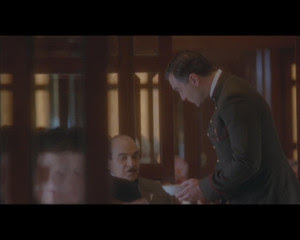
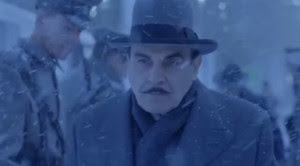
Directed by Philip Martin and written by Stewart Harcourt, "MURDER ON THE ORIENT EXPRESS" opened with Hercule berating a British Army officer, who has been revealed to be a liar in regard to a case. Upon completion of said case, Poirto travels over to Istanbul, the first step of his journey back to England. There, Poirot witnesses the stoning of a Turkish woman for adultery with a Colonel Arbuthnot and a Miss Mary Debenham. Thanks to an old acquaintance named Monsieur Bouc, a director of the Compagnie Internationale des Wagons-Lits (which owned the Orient Express lines), the detective manages to book passage aboard the famed continental train, the Orient Express. Among the passengers are Colonel Arbuthnot, Miss Debenham and a sinister American businessman named Samuel Rachett. The latter tries to hire Poirot’s services to protect him from unseen enemies; but the detective refuses due to a dislike toward the American. After the Orient Express becomes caught in a snowdrift in the middle of Yugoslavia, Rachett is found murdered in his compartment – stabbed to death twelve times. As it turned out, Poirot discovered that Rachett was a criminal named Casetti, who was guilty of kidnapping and murdering one Daisy Armstrong, the five year-old daughter of a wealthy Anglo-American couple. To protect the passengers from the Yugoslavia police, Monsieur Bouc hires Poirot to investigate the American’s murder.
Considering this film turned out to be the third, well-known adaptation of Christie’s novel, there were bound to be comparisons with the previous films – especially the famous 1974 version. All three movies featured changes from the novel. In this adaptation, screenwriter Stewart Harcourt decided to allow Poirot to witness the stoning of an adulterous Turkish woman. The characters of Doctor Constantine (a Greek doctor who volunteered to assist Poirot) and an American private detective named Cyrus Hardman were combined into a new character – an American obstetrician named . . . what else, Doctor Constantine. Rachett aka Casetti became a man who desired forgiveness for his kidnapping and murder of young Daisy. The brains behind Rachett’s murder turned out to be a different character. The Greta Ohlsson character was younger in this film. The movie featured a threat against Poirot’s life, after his resolution to the case. And the Orient Express remained snowbound a lot longer than in the novel and previous movies.
But the biggest change in "MURDER ON THE ORIENT EXPRESS" featured the addition of religion as a theme. In fact, the subject permeated throughout the entire movie. Television viewers saw scenes of both Poirot and surprisingly, Rachett, in the act of prayer. The movie also featured a discussion between Poirot and Miss Ohlsson on the differences between their dominations – Catholic and Protestant – and how they dealt with vengeance, justice, and forgiveness. Like many other Christie fans, I suspect that this addition of a religious theme was an attempt by Harcourt to allow Poirot to struggle with his conscience over his willingness to support Monsieur Bouc’s decision regarding the case’s solution.
There were some aspects of "MURDER ON THE ORIENT EXPRESS" that I found appealing. Due to the production’s budget, this adaptation spared the audience some of the over-the-top costume designs from the 1974 movie. The movie also featured first-rate performances from Denis Menochet (the best performance in the movie), who portrayed the car attendant, Pierre Michel; Brian J. Smith as Rachett’s private secretary, Hector McQueen; Barbara Hershey as the verbose tourist Mrs. Caroline Hubbard; Hugh Bonneville as Rachett’s valet, Edward Masterman; and Eileen Atkins as the imperious Princess Dragonmiroff. Despite portraying the only character not featured in the story, Samuel West gave an impressive, yet subtle performance as Dr. Constantine, whose occasional outrageous suggestions on the murderer’s identity seemed annoying to Poirot. I also have to give kudos to Harcourt for making an attempt to allow Poirot experience some kind of emotional conflict over the fate of Rachett’s killer(s). The novel never broached this topic. And in the 1974 film, Poirot twice expressed brief doubt and regret over the matter.
Despite some of the movie’s virtues, I found "MURDER ON THE ORIENT EXPRESS" rather disappointing. One of the biggest disappointments proved to be David Suchet’s performance. I have admired his portrayal of the Belgian detective for over a decade. But this movie did not feature one of Suchet’s better performances. In this movie, his Poirot struck me as harsh, judgmental and one-dimensional in his thinking. The movie also featured Poirot in full rant – against a British Army officer at the beginning of the story; and against the suspects, following the revelation scene. In fact, this last scene struck me as an exercise in hammy acting that made Albert Finney’s slightly mannered 1974 performance looked absolutely restrained.
Unfortunately, most of the cast did not fare any better. Joseph Mawle, who portrayed the Italian-American car salesman, Antonio Foscarelli, gave a poor attempt at an American accent. His British accent kept getting into the way. As for David Morrissey’s portrayal of Colonel Abuthnot, I could only shake my head in disbelief at such over-the-top acting – especially in the scene following Poirot’s revelation of the case. And I never understood the necessity of making the Mary Debenham character so anxious. Jessica Chastain’s performance did not exactly impress me and I found myself longing for the cool and sardonic woman from the novel and the 1974 version. I really did not care for Serge Hazanavicius’ portrayal of Monsieur Bouc, the train’s official. I found his performance to be ridiculously over-the-top and annoying. One could say the same about Toby Jones’ portrayal of Samuel Rachett aka Casetti. Poor Mr. Jones. I have been a big fan of his for the past five years or so, but he was the wrong man for this particular role. What made this movie truly unbearable was the last fifteen to twenty minutes, which became an exercise in overwrought acting by most of the cast. Including Suchet.
There were other aspects of this production that also bothered me. I never understood the necessity to change the instigator of the murder plot against Rachett. It made more sense to me to adhere to Christie’s original plot in that regard. And I found the use of religion not only unnecessary, but also detrimental to the story. I have nothing against characters with religious beliefs. But I found the scenes featuring both Poirot and Rachett praying in their compartments excessive. The religious topic transformed Poirot into a grim and humorless man. Even worse, I found myself wondering if Suchet's Poirot was suffering from some form of Post Traumatic Shock during the first fifteen to twenty minutes of the film. He seemed to moving in a state of silent shock, while others - especially Monsieur Bouc - talked around him. As for Rachett . . . I can only assume that the sight of him praying inside his compartment was supposed to be an indicator of his remorse over his crimes against Daisy Armstrong. Or did fear, instigated by a series of threatening letters, drove him to prayer? If so, the scene clumsily contradicted his other actions aboard the train – snarling at his employees and Pierre Michel, and propositioning Mary Debenham. The topic of religion also produced a tiresome scene filled with overwrought acting by Marie-Josée Croze, in which her character – Greta Ohlsson – lectured Poirot about the differences between Catholics and Protestants in regard to justice, revenge, forgiveness and remorse.
I found the stoning scene in Istanbul completely unnecessary and rather distasteful. I found it distasteful, because the scene changed Poirot’s character and allowed him to harbor a laissez faire attitude over the incident. Poirot also used the stoning scene to indulge in an excessive lecture to Mary Debenham about justice. He was right about the stoning being a part of a custom that no foreign visitor had a right to interfere. But his entire attitude about the matter did not seem like the Hercule Poirot I had become familiar with from Christie’s books, the movies and the "POIROT" series. Worse, the incident provided a contradicting viewpoint on vigilantism and justice. Think about it. Poirot said nothing against the stoning, which was an act of vigilantism, because not only did he view it as a foreign custom, but also as an act of justice against someone who had sinned. Yet, at the same time, he expressed outrage and disgust over Rachett’s murder – also an act of vigilantism. The entire topic reeked of hypocrisy and bad writing.
There is one last aspect of this production that I found troubling. Why did Harcourt deleted Poirot's official questioning of three characters? I am referring to Mary Debenham, Colonel Abuthnot and Antonio Foscarelli. He never sat down to officially interview any of these suspects. He talked to both Miss Debenham and Colonel Abuthnot, while he was slowly exposing the mystery. Later, he and Miss Debenham had a discussion about the stoning incident in Istanbul and Rachett/Cassetti's murder. And Foscarelli tried to emphasize that not all Italians were mobsters in America. But he never really interrogated these suspects. Why?
"MURDER ON THE ORIENT EXPRESS" possessed some virtues that its filmmakers could boast about. Performances from Brian J. Smith, Eileen Atkins, Hugh Bonneville, Barbara Hershey and especially Denis Menochet were first-rate. There were no over-the-top costumes that left me shaking my head. And thankfully, the Hector McQueen character strongly resembled the literary version. On the other hand, the movie seemed riddled with unnecessary changes that either lacked common sense or damaged the story. Its additions of the religion topic and stoning incident simply made matters worse in regard to story and characterization. And a good deal of hammy acting abounded in the movie and made me wince with discomfort, especially from David Suchet. In conclusion, this "MURDER ON THE ORIENT EXPRESS" turned out to be a slightly disappointing affair for me.