I wrote this commentary on the eighth episode of "THE PACIFIC": "THE PACIFIC" (2010) Episode Eight "Iwo Jima" CommentaryThe eighth episode of "THE PACIFIC" managed to affect me in a very emotional way. To my great surprise. And I find this amazing. After all, I knew what it was about – namely John Basilone’s return to active duty, along with his courtship and marriage to fellow Marine, Sergeant Lena Riggi. And I knew how it would end. Yet, Episode Eight had a great emotional impact upon me. In a nutshell, the episode began with a glimpse of Eugene Sledge and his fellow 5th Regiment Marines at Pavuvu, recovering from their ordeal on Peleliu. Not much really happened in this little sequence. Eugene discovered that someone had tossed one of the late Captain Haldane’s books into the garbage. He became irritated by ‘Snafu’ Shelton’s claims of coming down with a tropical disease. The sequence ended with Jay De L'Eau informing Sledge and Shelton that he had been transferred to either regimental or company headquarters.The meat of Episode Eight centered on the last months of one Gunnery Sergeant John Basilone. The beginning of the episode featured Basilone and his brothers participating at a radio program at NBC in New York City. Whereas his brothers and the rest of the family seemed thrilled by the Marine’s celebrity, he seemed sick to his stomach. No longer able to deal with the publicity and longing to return to active duty, Basilone reenlisted into the Marines. He found himself at Camp Pendleton, California; transferred to the Fifth Marines Division. Among the new recruits assigned to his company are future war hero Charles “Chuck” Tatum and Steve Evanson. The two ended up becoming While Basilone prepared them and other recruits for combat, he met the love of his life – Marine Sergeant Lena Piggi. I could say that it was love at first sight for the both of them, but I would be lying. Basilone obviously fell completely in love with Lena. However, she did not seem to want anything to do with him. At first. But when she realized that the war hero had no interest in simply wooing her for the sake of a one-night stand or two during a breakfast date, she finally opened her feelings toward him. After learning that his division was about to be shipped overseas, Basilone proposed marriage to Lena . . . and she accepted. But all good things must come to an end. And it did for Basilone; when he, Tatum, Evanson and the rest of the Fifth Marines landed smack into the violence and chaos of Iwo Jima. When I had first contemplated Basilone’s fate a few days before Episode Eight had aired, I found myself crying. And I asked myself . . . why? After all, I knew that the Marine hero would die. So, I dismissed my little outburst of emotion and anticipated the episode. And I watched it. I enjoyed Basilone’s interactions with Tatum and Evanson, and their humorous reactions to his training. I especially enjoyed his courtship of Lena and the peek into wartime New York and Southern California. I spent most of the Iwo Jima sequence holding my breath and wincing at the graphic violence that unfolded. But it was not until my family and I discussed the manner of Basilone’s death that I found myself on the verge of tears again. The following day, I found myself thinking about the episode . . . and I cried again. It finally occurred to me that Episode Eight had an underlying sense of doom that I found slightly depressing. It was interesting that Andrew Haldane’s death, which took me by surprise, barely affected me. Yet, Basilone’s death had a strong impact upon me. Of course it did. I had been emotionally invested in Basilone since the first episode. And Jon Seda’s subtle and spot-on portrayal of the war hero had a lot to do with that. The fact that he found true love just before departing for Iwo Jima made his death all the more poignant. Actress Annie Parisse gave a complex and feisty performance as Basilone’s wife, Lena Riggi Basilone. More importantly, she and Seda created a strong screen chemistry. And I found Ben Esler and Dwight Braswell rather hilarious as the two friends and witnesses to Basilone’s last months, Chuck Tatum and Steve Evanson. In many ways, they almost seemed like a comedy act. It seemed a pity that they would only be featured in this episode.Many have complained that the Iwo Jima battle sequence could have lasted longer. I honestly do not see how. The episode more or less covered the events leading to his death. And he was killed during the battle’s first day. I believe that screenwriters Robert Schenkkan and Michelle Ashford were right to focus most of the episode on his months at Camp Pendleton and his courtship of Lena Riggi. The fact that his death capped a romantic episode made it all more poignant and slightly depressing for me. However, I do have one complaint about the episode – namely the Sledge sequence. I simply found it unnecessary. Unless Episode Nine end up proving otherwise, I could not see how the events on Parvuvu continued Sledge’s story.But despite the Parvuvu sequence, I still enjoyed Episode Eight. Superficially, it did not seem like it would prove to be one of the miniseries’ better episodes. But the love story between John Basilone and Lena Riggi, topped by his death at Iwo Jima, made it – at least for me – one of the most poignant ones in the series.
”TAKEN” (2009) ReviewLuc Besson and Robert Mark Kamen wrote this tight thriller about a retired CIA agent who tracks down his daughter after she was kidnapped by Albanian criminals engaged in the sex slave traffic, while traveling in Europe. Directed by Pierre Morel, the movie stars Liam Neeson, Maggie Grace, Famke Janssen and Olivier Rabourdin. Neeson stars as Bryan Mills, a divorced, former paramilitary officer from the CIA's famed Special Activities Division. His 17-year-old daughter Kim (Maggie Grace) lives with his ex-wife Lenore (Famke Janssen) and her new wealthy husband Stuart (Xander Berkeley). After Kim accompanies her close friend, Amanda (Katie Cassidy) to Europe, they are kidnapped by sex trade traffickers from the apartment they share in Paris. Since Mills was talking to Kim at the time the kidnapping took place, he is able to get some information on who may have snatched her and Amanda before heading to Paris to track them down.I am going to put my cards on the table. I enjoyed ”TAKEN” . . . a lot. It was a fast paced thriller filled with the usual stuff one can find in a top-notch action film – exciting car chases, tension, well choreographed fight scenes and sharp acting. I would not view it as an exceptional film. If I have to be honest, there is nothing new in this film that I have not seen in previous action thrillers. It also had its share of clichés that usually pop up in other action films. But I still enjoyed it. If there is one thing I must commend upon the movie is the level of global involvement in the sex slave traffic. Morel and screenwriters Besson and Kamen not only involved Kim’s Albanian kidnappers into the trade, but also French government officials and customers from all over the globe.The cast did a pretty good job. But I was particularly impressed by four actors in particular. Olivier Rabourdin was surprisingly interesting as Jean-Claude - an old friend of Mills’ who also happens to be a former operative and now deputy director of the French intelligence agency. At first, I had assumed that Rabourdin would act as an ally who would help Mills in his search for his daughter. But thanks to Rabourdin’s performance, his role turned out to be surprisingly more ambiguous. I was also impressed by Famke Janssen’s performance as Mills’ ex-wife, Leonore. This was a different Janssen, who portrayed an uptight woman still harboring some residual of bitterness toward Mills and the way their marriage had ended. And I have to give kudos to Maggie Grace for effectively portraying a character that was at least seven to eight years her junior. Although I am certain that many actresses in their mid-twenties have portrayed a teenager, I have rarely come across many that were as convincing as Grace. She was excellent. Liam Neeson must have been at least fifty-five years old when he filmed ”TAKEN”. Mind you, there have been other actors around his age or older who have managed to convincingly portray action characters. But his performance as Bryan Mills could give Jason Bourne or James Bond some stiff competition. Granted, his interactions with the various thugs and bodyguards almost made him seem unnaturally superhuman. But if one might as well accuse Matt Damon’s Bourne or Daniel Craig’s Bond of the same thing. Thankfully, Neeson’s Mills was more than just an above-average action hero. The Irish-born actor also infused his character with all of the emotional angst, paranoia and anger any father would face at the prospect of one’s child being snatched by strangers and placed into danger.I do have one major complaint about ”TAKEN” - namely the photography and editing featured in the movie. Like ”THE BOURNE SUPREMACY”, ”THE BOURNE ULTIMATUM” and ”QUANTUM OF SOLACE” before it, ”TAKEN” is filled with that ”shaky camera” technique that I loathe so much. I realize that this technique was used to give a film an ad-hoc, news, or documentary feel. Frankly, I have never seen the need for to give action movies such as ”TAKEN” this type of style for action films, with the exception of movies based upon real life dramas or war movies. Thanks to director Morel, cinematographer Michel Abramowicz, and editor Frédéric Thoraval; the shaky camera technique only made me feel dizzy and frustrated. I am thankful that the fight scenes – especially in the film’s last twenty minutes – did not seem affected by this technique. However . . . Paul Greengrass, who directed the last two ”BOURNE” films, has a lot to answer for making this filming technique popular for action films.In a nutshell, ”TAKEN” is not exactly what I would call an original film. It utilized many of the typical clichés used in action films. And the subject – the sex slave traffic – has been told with greater detail in such productions like 2005’s”HUMAN TRAFFICKING”. And the shaky camera technique used by Morel, Abramowicz and Thoraval made it difficult for me to enjoy some of the actions scenes, especially those featuring car chases. But thanks to a first-rate cast led by Liam Neeson and Maggie Grace, solid direction by Morel and a straightforward script written by Besson and Kamen,”TAKEN” is a tense, yet entertaining film that I found very satisfying. I enjoyed it so much that I purchased a copy of it as soon as it was released on DVD.
JANEWAY'S DECISION IN "STAR TREK VOYAGER" (3.04) "The Swarm"
Over an hour ago, I had just finished watching the early Season Three "STAR TREK: VOYAGER" episode, (3.04) "The Swarm". And after watching it, I was reminded on why I have disliked it so much for so many years.
Although most of the story focused around Kes' efforts to save the Doctor's degrading matrix, the B-plot focused around Voyager's efforts to cut short fifteen months of their journey by trespassing through the territory of a species named by Voyager's crew as the Swarm. Now, Chief of Security, then Lieutenant Tuvok tried to remind Captain Kathryn Janeway that the territory belonged to these aliens and that they had every right not to allow other travelers through their space. After two seasons, Janeway decided to adopt the "Maquis way" and ignore Tuvok. Instead, she labeled the Swarm as"bullies" - as if that was a sufficient reason for Voyager to commit trespassing - and led the ship into "the Swarm's" space.
I am quite certain that most Trek fans would disagree with me, but I found Janeway's actions to be more of a "bully" than the Swarm. If some aliens had decided to trespass into Federation space, despite Starfleet's decision to ban them, I bet that both Janeway and Chakotay would be among the first to defend Starfleet's decision. But being the arrogant Starfleet officers they were, I guess they decided that they simply lacked the patience to add fifteen months to a journey that already left Voyager with 68 or 69 years left to reach Earth. Fifteen months against 68 or 69 years. Hmmmm. Was Janeway's effort to ignore "the Swarm's" wishes really worth it? Personally . . . I do not think so.
During the series' the first two seasons, Janeway struggled to rigidly stick to Starfleet protocols. In "The Swarm", she decided to drop this command style and adopt Chakotay's method of utilizing "the Maquis way". This decision eventually led to Janeway's disastrous alliance with the Borg during their war against Species 8472.
I have read both Jim Wright and Julia Houston's reviews of this particular episode. Wright practically celebrated Janeway's decision to ignore Tuvok's advise and trespass into the Swarm's territory. Frankly, I was not surprised. During the show's first three seasons, Wright had made it clear that he disliked Tuvok. In fact, I can only wonder if his dislike of Tuvok had blinded him to Chakotay's constant taunting of the Vulcan during the show's first season. Apparently, anything that would cut the Vulcan down to size seemed to satisfy him. And I also noticed that he also seemed to enjoy a vicarious thrill in Janeway telling the Swarm to go fuck themselves. Perhaps her aggressive move brought back memories of the "good old days" of Captain James T. Kirk's arrogant "gunboat diplomacy" attitude toward various species hostile toward the Federation.
Then I read Julia Houston's review. Although she seemed to believe that Tuvok was right in advising Janeway not to invade the Swarm's territory, a small part of her felt a "twinge of imperialistic satisfaction" that Voyager did it anyway. Apparently, the Swarm's attitude to keeping invaders at bay irked her. What can I say? I get the feeling that deep down, she was just as thrilled as Wright.
Frankly, I found Janeway's decision a little repellent. Then again, I have never cared for any of the other Starfleet captains' arrogant attitude toward other aliens. It was this same attitude that led Starfleet to ignore the Dominion's wishes and invade their space in the Gamma Quadrant in "STAR TREK: DEEP SPACE NINE". A decision that led to a brutal two-year war against the Dominion. I also recalled an "STAR TREK: ORIGINAL SERIES" episode called (1.23) "A Taste of Armageddon" in which Jim Kirk forced two societies to end their war by destroying the computers that had conducted the war, and insisted that Federation society was better than theirs. This act forced the two warring aliens to turn to the Federation in the end. That episode had repelled me just as much as Janeway's decision in "The Swarm". Kirk's intent may have been noble, but the manner in which he stopped a war that had no impact upon the Federation struck me as the arrogant moves of a bully.
Do not get me wrong. I am a big fan of the STAR TREK franchise. I always have been a fan and I always will be one. But there are some aspects of the STAR TREK franchise (both movies and television) that has turned me off. One of those aspects was the habit of Starfleet captains making arrogant decisions against the wishes of those aliens they sometimes encounter. Decisions that the Federation would have definitely resented if some group of aliens had done the same to them. I guess that in their view, what is good for the Federation (or Starfleet) was not good for those other aliens. I find such attitudes rather distasteful.
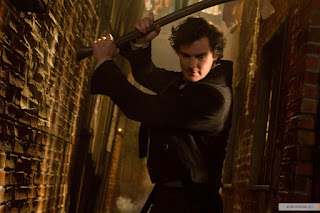 Below are images from the 2012 supernatural thriller, "ABRAHAM LINCOLN: VAMPIRE HUNTER". Based upon Seth Grahame-Smith's 2010 novel and directed by Timur Nuruakhitovich Bekmambetov, the movie starred Benjamin Walker, Dominic Cooper, Mary Elizabeth Winstead and Anthony Mackie:"ABRAHAM LINCOLN: VAMPIRE HUNTER" (2012) Photo Gallery