Friday, April 16, 2021

"THE ACCOUNTANT" (2016) Review

 kinopoisk.ru-The-Accountant-2817345


"THE ACCOUNTANT" (2016) Review

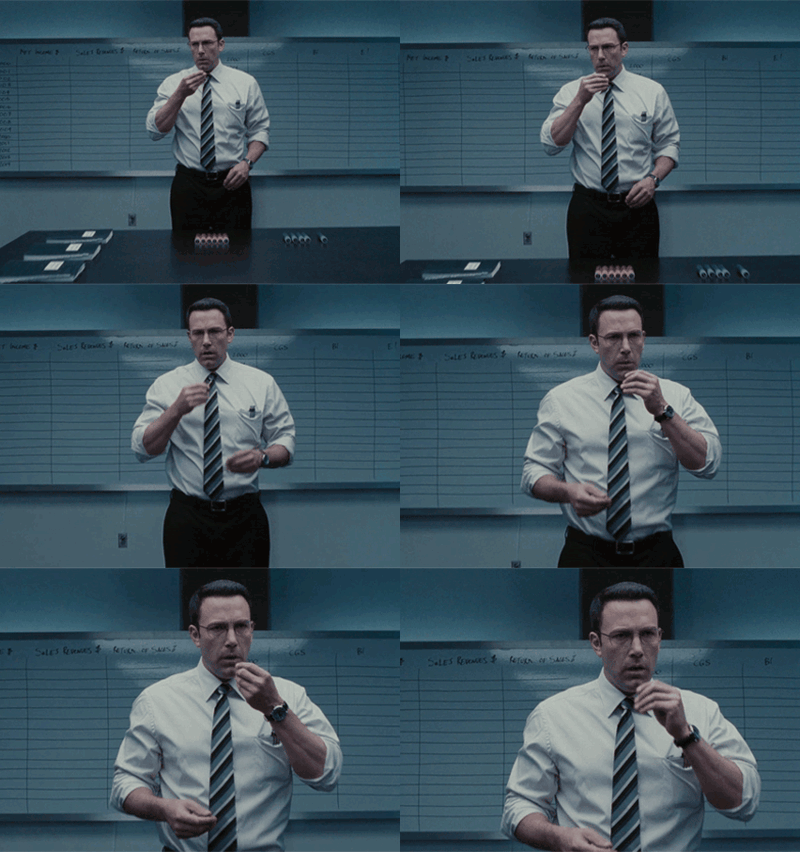
I have seen some unusual crime dramas in my life. Most of these films or television programs usually revolved around odd narrative structures, characters in unusual situations or characters with eccentric ticks. And I have also seen the occasional film about autistic characters. But for the likes of me, I cannot recall seeing a crime drama of any form in which the main character is autistic . . . until I saw the recent film, "THE ACCOUNTANT".

Written by Bill Dubuque and directed by Gavin O'Connor, "THE ACCOUNTANT" told the story of Christian Wolff, a mental calculator who works as a forensic accountant at ZZZ Accounting in Plainfield, Illinois. Christian also tracks insider financial deceptions for numerous criminal enterprises. His services are brokered to him by a "Voice on his phone", from a restricted number. Christian had been diagnosed with a high-functioning form of autism and offered an opportunity to live at Harbor Neuroscience Institute in New Hampshire. However, his Army officer father thought otherwise and decided Christian learn to overcome his autism via extensive training in martial arts and sharpshooting. This decision drove Christian's mother to leave his family, which included a younger brother.

The story begins with "The Voice" giving Christian a new assignment - auditing state-of-the-art robotics corporation Living Robotics, whose in-house accountant, Dana Cummings, has found suspicious financial discrepancies. The company's CEO and his sister, Lamar Blackburn, and his sister, associate Rita Blackburn, willingly cooperate with Christian's investigation; but CFO Ed Chilton dismisses Dana's findings as a mistake. When Christian - with minor help from Dana - eventually discover the embezzlement of $61 million dollars from the company, a hitman named Braxton forces the diabetic Chilton to self-administer a fatal insulin overdose by threatening to kill both him and his wife brutally in the manner of a home invasion. The Blackburns later surmises that Chilton was the embezzler and close the investigation, leaving Christian distraught as he has not completed his study. However, the embezzler decides that both Christian and Dana still poses a major threat and instructs Braxton and his men to kill the pair. At the same time, Christian's past activities have attracted the attention of Raymond King, the director of FinCEN in the Treasury Department, who recruits a young data analyst named Marybeth Medina into helping him identify and arrest Christian. He does this via blackmail by threatening to expose her undeclared criminal past if she refuses.

Judging from the above mentioned plot, one would surmise that "THE ACCOUNTANT" has a complicated plot. I would not say that. I would not label Dubuque's screenplay as simplistic or unoriginal. But I must admit that the embezzlement plot was not exactly a brain teaser for me. It did not take me very long to figure out the identity of the embezzler and Braxton's client. More importantly, Christian's final encounter with the embezzler ended on a . . . well, anti-climatic note for me. Let me rephrase this. That final encounter started out rather exciting, due to Christian's fights with Braxton and his men, who found themselves serving as the embezzler's bodyguard. But the manner in which that entire action scene ended struck me as anti-climatic and rather disappointing.

Despite its ending, I must admit that I found most of "THE ACCOUNTANT" rather enjoyable. The creme of the movie proved to be its deep exploration of the Christian Wolff character struck me as very interesting - especially the flashbacks featuring his childhood and the tragic circumstances that led to his father's death. The story delved into his problems with overcoming his autism, his father's refusal to consent professional counseling for his, and his struggles to interact with others. The movie also explored Christian's few successes in forming relationships with a small handful of people that include his younger brother; the mute daughter of the Harbor Neuroscience Institute's director named Justine; an accountant he had met during a brief stint in prison named Francis Silverberg; an Illinois farm couple that allowed him to practice his sharpshooting on his property; and Dana Cummings. I was also taken by surprised by Christian's connection to FinCEN Agent King and the latter's reason for coercing Agent Medina to investigate the case. Perhaps this is why "THE ACCOUNTANT" worked better as a character study/crime drama . . . without the mystery of the embezzler's identity attached to it.

"THE ACCOUNTANT" featured some solid performances from the supporting cast that included John Lithgow, Jean Smart, Jeffrey Tambor, Andy Umberger, Alison Wright, Robert C. Treveiler, Ron Prather and Susan Williams. But I especially enjoyed Jon Bernthal's performance as the ruthless, yet sardonic hit man, Braxton. I also enjoyed Cynthia Addai-Robinson's portrayal as the blackmailed Agent Marybeth Medina, whose fear of being exposed gradually crumbled away due to a desire to pursue justice. J.K. Simmons gave an interesting performance as Agent Ray King, whose ruthless pursuit of Christian proved to be unusually emotional. Anna Kendrick gave a rather charming performance as accountant Dana Cummings, whose original response to Christian seemed to be one of bewilderment. As the two become close, both Kendrick and Ben Affleck developed a charming, sibling-like chemistry on-screen.

Speaking of Affleck, I thought he gave one of the most interesting performances of his career, so far. I realize that many critics and moviegoers tend to overlook Affleck's acting skills - something that I never understood - but I thought he really knocked it out of the ballpark portraying a character who was not only a highly skilled ex-military type, but also someone who is both a mental calculator and is autistic. Hollywood has featured a lead who is autistic (1988's "RAIN MAN") and even a young autistic boy who had witnessed a murder (1998's "MERCURY RISING"). But a leading man in an action film? The character of Christian Wolff and Ben Affleck's performance was something quite new to me.

Yes, I will admit that I was a little disappointed by the mystery surrounding the movie's embezzling plot. I was also a bit disappointed by how the movie's final action sequence ended. I found it a bit too anti-climatic. But I really enjoyed the rest of the movie, especially its portrayal of the main character, Christian Wolff. I thought director Gavin O'Connor handled both an interesting story created by screenwriter Bill Dubuque and an excellent cast, led by the talented Ben Affleck, in what I believe might be one of his most interesting roles.


Thursday, April 8, 2021

CraftEars on ETSY


CraftEars on ETSY

Hey y'all!  Sparkle and shine at your favorite theme park from Spring Break to New Year's Eve and right through Mardi Gras.  You'll never be out of season.  Check out CraftEars' work at Etsy through this LINK!

Friday, March 26, 2021

"PERIL AT END HOUSE" (1990) Photo Gallery

 peril poirot


Below are images from "PERIL AT END HOUSE", the 1990 television adaptation of Agatha Christie's 1932 novel. The movie starred David Suchet as Hercule Poirot:


"PERIL AT END HOUSE" (1990) Photo Gallery

0


5538_1


5538_6_large


5538_7_large


5538_8_large


5538_9_large


5538_10_large


5538_11_large


5538_12_large


5538_13_large


5538_14_large


7524265970_e808874ff1_z


7524266102_5f2e19bf5d_z


eG9tczhzMTI=_o_s2e1p2-2-agatha-christies-poirot---peril-at-end-house


maxresdefault


peril film


Peril_at_End_House_-_still2


Poirot+1


poirotjapp


salcombe2

Sunday, March 21, 2021

"SILAS MARNER" (1985) Review


"SILAS MARNER" (1985) Review

I have seen a handful of television and movie adaptations of novels written by George Eliot. But the very first adaptation I ever saw was "SILAS MARNER", the 1985 version of Eliot's third novel published back in 1861. My recent viewing of the production led me to reasses it.

"SILAS MARNER" begins with an English weaver living with a small Calvinist congregation in Lantern Yard, a slum street in a Northern England city. His life falls apart when he is framed for stealing the church's funds, while watching over the congregation's ill deacon. Worse, his fiancee leaves him for his so-called best friend, the very man who may have framed him. Shattered and embittered, Silas leaves Lantern Yard and arrives at a rural village in the Midlands called Raveloe. Although he resumes his trade as a weaver, Silas' traumatized past leads him to achieve a reputation as a miser and a loner in the community.

Silas' move to Raveloe eventually leads him to cross paths with the community's leading citizens, the Cass family. The head of the latter is the elderly Squire Cass who has two sons - Godfrey and Dunstan. Godfrey, who is the squire's heir is secretly married to one Molly Farren, a lower-class woman and opium addict from another town, who has given birth to his young daughter. Godfrey is also engaged to a young middle-class woman named Nancy Lammeter. Dunstan is a dissolute wastrel who constantly loses money via excessive gambling. One night, a drunken Dunstan breaks into Silas' cottage, steals the gold coins that the latter has been hoarding and disappears. Through a series of events, Molly plots to expose her marriage to Godfrey and their child during the Cass family's New Year party, but dies in the snow before she can reach it. Silas, who is emotionally upset over the loss of his coins, finds both the dead Molly and the child. Although he informs the partygoers of Molly's death and the child, he assumes guardianship of the latter (renamed Hephzibah "Eppie"), much to the relief of Godfrey, who can now legally marry Nancy. All goes well until Godfrey and Nancy's failure to have children threaten Silas' newfound happiness as Eppie's father years later.

What can I say about "SILAS MARNER"? I can honestly say that it was not one of the best adaptations of a George Eliot novel. Then again, I do not consider the 1861 novel to be one of her best works. I realized that Eliot had set the story either around the end of the 18th century or around the beginning of the 19th century. It was her prerogative. But both the novel and the movie seemed to reek of Victorian melodrama that I found myself feeling that Eliot or any adaptation could have set the story around the time it was originally written and published - the mid 19th century. The story is, at best, a good old-fashioned Victorian melodrama. I would never consider it as particularly original in compare to the likes of "MIDDLEMARCH" or "DANIEL DERONDA".

"SILAS MARNER" tries its best to be profound on the same level as the other two Eliot stories I had mentioned. But I had a few problems with the narrative. What was the point behind Dunstan Cass' disappearance and theft? Yes, he stole Silas' hard earned money before he disappeared. I got the feeling that the stolen coins seemed to serve as a prelude to Silas' emotional attachment to Eppie. But why have Dunstan take it? How else did his disappearance serve the story . . . even after his dead remains were found close by, years later? In Eliot's novel, the discovery of Dunstan led brother Godfrey to form a guilty conscience over his own secret regarding young Eppie and confess to his wife. But in the movie, it was Godfrey and Nancy's inability to conceive a child that seemed to finally force the former to confess. Unless my memories have played me wrong. Frankly, Dunstan struck me as a wasted character. Anyone else could have stolen Silas' money.

I also noticed that Giles Foster, who had served as both screenwriter and director for this production, left out a few things from Eliot's novel. I have never expect a movie or television to be an accurate adaptation of its literary source. But I wish Foster had shown how Eppie's presence in Silas' life had allowed him to socially connect with Raveloe's villagers. Eliot did this by allowing her to lead him outside, beyond the confines of his cottage. The only person with whom Silas managed to connect was neighbor Dolly Winthrop, who visited his cottage to deliver him food or give advice on how to raise Eppie. I also noticed that in the movie, Silas had never apologized to another villager named Jem Rodney for his false accusation of theft. And Jem had never demanded it. How odd. I also wish that Foster could have included the segment in which Silas had revisited his former neighborhood, Lantern Yard. In the novel, Silas' visit revealed how the neighborhood had transformed into a site for a factory and its citizens scattered to other parts. Silas' visit to his old neighborhood served as a reminder of how his life had improved in Raveloe and it is a pity that audiences never saw this on their television screens.

Yes, I have a few quibbles regarding "SILAS MARNER". But if I must be really honest, I still managed to enjoy it very much. Eliot had written a very emotional and poignant tale in which a lonely and embittered man finds a new lease on life through his connection with a child. Thanks to George Eliot's pen and Giles Foster's typewriter, this story was perfectly set up by showing how Silas Marner's life fell into a social and emotional nadir, thanks to the betrayal of a "friend" and the easily manipulated emotions of his neighbors.

Once Silas moved to Raveloe, the television movie did an excellent, if not perfect, job of conveying how he re-connected with the world. It was simply not a case of Silas stumbling across a foundling and taking her in. Even though he had formed a minor friendship with Mrs. Winthrop, having Eppie in his life managed to strengthen their friendship considerably. The movie's narrative also took its time in utilizing how the Cass family dynamics played such an important role in Silas' life in Raveloe. After all, Godfrey' secret marriage to Molly Farren brought Eppie into his life. And Dunstan's theft of his funds led Silas to re-direct his attention from his missing coins to the lost Eppie. And both Godfrey and Nancy Cass proved to be a threat to Silas and Eppie's future relationship.

The production values for "SILAS MARNER" proved to be solid. But if I must be honest, I did not find any of it - the cinematography, production designs and costume designs - particularly memorable. The performances in the movie was another matter. "SILAS MARNER" featured solid performances from the likes of Rosemary Martin, Jim Broadbent (before he became famous), Nick Brimble, Frederick Treves, Donald Eccles, Rosemary Greenwood; and even Elizabeth Hoyle and Melinda White who were both charming as younger versions of Eppie Marner.

Angela Pleasence certainly gave a memorable performance as Eppie's drug addicted mother, Molly Farren. Patsy Kensit not only gave a charming performance as the adolescent Eppie, I thought she was excellent in one particular scene in which Eppie emotionally found herself torn between Silas and the Casses. Freddie Jones gave his usual competent performance as the emotional Squire Cass, father of both Godfrey and Dunstan. I was especially impressed by Jonathan Coy's portrayal of the dissolute Dunstan Cass. In fact, I was so impressed that it seemed a pity that his character was only seen in the movie's first half.

I initially found the portrayal of Nancy Lammeter Cass rather limited, thanks to Eliot's novel and Foster's screenplay. Fortunately, Nancy became more of a central character in the film's second half and Jenny Agutter did a skillful job in conveying Nancy's growing despair of her inability to have children and her desperation to adopt Eppie. I thought Patrick Ryecart gave one of the two best performances in "SILAS MARNER". He did an excellent job of conveying Godfrey Cass' moral ambiguity - his secrecy over his marriage to Molly Farren, the passive-aggressive manner in which he "took care" of Eppie through Silas and his willingness to use Eppie as a substitute for his and Nancy's failure to have children. Ryecart made it clear that Godfrey was basically a decent man . . . decent, but flawed. The other best performance in "SILAS MARNER" came from leading man Ben Kingsley, who portrayed the title character. Kingsley did a superb job of conveying Silas' emotional journey. And it was quite a journey - from the self-satisfied weaver who found himself shunned from one community, to the embittered man who stayed away from his new neighbors, to a man experiencing the joys and fears of fatherhood for the first time, and finally the loving man who had finally learned to re-connect with others.

Overall, "SILAS MARNER" is more than a solid adaptation of George Eliot's novel. I did not find its production designs particularly overwhelming. I did enjoy Eliot's narrative, along with Giles Foster's adaptation rather enjoyable . . . if not perfect. But I cannot deny that what really made this movie work for me were the first-rate performances from a cast led by the always talented Ben Kingsley. Victorian melodrama or not, I can honestly say that I have yet to grow weary of "SILAS MARNER".

Sunday, March 7, 2021

"CENTENNIAL" (1978-79) - Episode Ten "The Winds of Fortune" Commentary


"CENTENNIAL" (1978-79) - Episode Ten "The Winds of Fortune" Commentary

This tenth episode of "CENTENNIAL" called "The Winds of Fortune" marked the last one set in the 19th century. The episode also featured the end of several story lines - the troubles with the Pettis gang, Axel Dumire's suspicions of the Wendell family, Hans Brumbaugh's labor problems and Jim Lloyd's romantic problems with Charlotte Seccombe and Clemma Zendt.

The range war that the ranchers began in "The Shepherds" finally gasped its last breath in this episode. The last remnants of the Pettis gang (the killers hired by the ranchers to get rid of the farmers and shepherds) make one last attempt to exact revenge against Amos Callendar, Jim Lloyd and Hans Brumbaugh - the three men who had killed Frank and Orvid Pettis in revenge for the deaths of two friends. Naturally, it failed during a gunfight against, Jim, Amos and the latter's son.

The Pettis gang's revenge attempt also led to the closure of the story line that featured Sheriff Axel Dumire and the Wendell family. The gunfight at Amos' homestead allowed one Pettis killer to escape back to Centennial . . . but not for long. Dumire led a manhunt for the escaped killer. And in a dark alleyway, he and the Pettis outlaw mortally shot each other. While the outlaw died right away, Dumire suffered a slow death. Before expiring, he summoned young Philip Wendell for a last attempt to learn the truth about the now dead Mr. Sorenson. Although he failed, Philip expressed grief and remorse over his dead body.

Jim Lloyd and Charlotte Seccombe's courtship finally led to a marriage proposal from the former. But their engagement encountered troubled waters when Clemma Seccombe returned to Centennial. Unable to get over his infatuation with the seemingly repentant Clemma, Jim breaks his engagement with Charlotte. The latter tries to bribe Clemma to leave town. But in the end, it took a lecture from Lucinda Zendt to convince the latter to leave. And Charlotte finally married her cowboy. Hans Brumbaugh's labor problems finally ended when political turmoil in Mexico finally drove Tranquilino Marquez to accompany his uncle, "Nacho" Gomez to Colorado. "Nacho" never made it, dying from a gunshot wound on the Skimmerhorn Trail. But Tranquilino and a few fellow Mexicans made it to the Brumbaugh farm and became permanent employees. Unfortunately for Tranquilino, good luck became bad during a trip to Denver, where he found himself imprisoned on a trumped up charge by a local bigot with a dislike for Latinos.

As you can see, a great deal happened in "The Winds of Change". Normally, I would have insisted upon a longer running time than 97 to 100 minutes. But screenwriter Charles Larson and director Harry Falk managed to keep the episode's pace flowing perfectly without any rush or dragging, whatsoever. Following James Michner's novel, they also managed to do an excellent job of connecting the final acts of the two story lines featuring the Pettis gang and the Wendells. At the same time, Jim Lloyd's romantic travails continued during this traumatic time for Centennial.

"The Winds of Fortune" featured at least three outstanding scenes that I need to point out. At least two of those scenes featured deaths of primary characters. Once again, Brian Keith and Doug McKeon knocked it out of the ballpark with their portrayals of Sheriff Axel Dumire and Philip Wendell in a poignant, yet ironic scene that featured the former's death. What I found particularly ironic about this particular scene is that the characters' deep affection for each other could not overcome Dumire's desire to know the truth about Mr. Sorenson's death or Philip's determination to protect his parents to the bitter end.

Another death scene featured "Nacho" Gomez's death on the Skimmerhorn Trail, while he and Tranquilino journey to Colorado. Although A Martinez was pretty solid as Tranquilino, Rafael Campos gave one last superb performance as the dying "Nacho" recalled the best period of his life - those months along the Skimmerhorn Trail. In fact, his character died near the very spot where he first met John Skimmerhorn in "The Longhorns". The last scene was the final confrontation between Clemma and Lucinda Zendt and Charlotte Seccombe. Between Charlotte's determination to pay off Clemma to get her out of Jim's life, and the latter's acidic crowing over her hold of said cowboy, the scene crackled with hostility, thanks to the superb acting of Lynn Redgrave and Adrienne La Russa. Christina Raines gave solid support as Clemma's disapproving mother, Lucinda.

The episode also boasted first-rate performances from William Atherton, who continued his superb portrayal of the solid, yet love sick cowboy Jim Lloyd. Another excellent performance came from Cliff De Young, who shined as ranch manager John Skimmerhorn, in one of his final scenes in which he expressed the blunt truth about the fickle Clemma. The episode also featured fine work from Alex Karras (Hans Brumbaugh), Jesse Vint (Amos Calendar) and delicious performances from both Lois Nettleton and Anthony Zerbe as the conniving Maude and Mervin Wendell.

"The Winds of Change" featured one major problem with me. Ever since "The Storm", the miniseries usually featured flashbacks that hinted a major character's upcoming death. Prolonged flashbacks from "The Longhorns" nearly grounded the episode to a halt, as a dying "Nacho" recalled the events of the Skimmerhorn drive. I could have tolerated one or two scenes. But the flashbacks nearly seemed to go on forever.

Despite the never-ending flashbacks, "The Winds of Change" proved to be another outstanding episode of "CENTENNIAL". Since it became the last episode to be set during the 19th century, it featured the conclusions of several story lines that have been going on since the saga shifted into the 1880s. It was a near perfect finale to what proved to be a rather interesting period of four to five episodes.


Thursday, March 4, 2021

"TITANIC" (1953) Photo Gallery

 titanic2 (1)

Below are images from "TITANIC", the 1953 movie version of the sinking of the S.S. Titanic. Directed by Jean Negulesco, the movie stars Barbara Stanwyck, Clifton Webb, and Robert Wagner:


"TITANIC" (1953) Photo Gallery

7


8


26


00581czk


00588hke


1953-titanic


1042356_320


29019606


2411616838_38fda21923_z


article-1060432-02C519DF00000578-190_468x456


el_hundimiento_del_titanic_1953_1-600x337


furglamor-1953-titanic-1953-03


TITANIC_1953-31


Titanic-1953-1


titanic-1953-1-1

Sunday, February 28, 2021

"IRON MAN 3" (2013) Review


"IRON MAN 3" (2013) Review

One would think after the release of last year's "THE AVENGERS", Marvel Studios would call it quits on its saga about the team of superheroes who foiled an alien invasion in said movie. But the "THE AVENGERS" opened the possibility of a new threat to Earth, paving the way for a new slew of stories for the costumed Avengers.

The beginning of this new group of films resulted in the release of "IRON MAN 3", the third movie about the sole adventures of billionaire Tony Stark aka Iron Man. The alien invasion from "THE AVENGERS" had left its mark on Tony. He has become even more popular than ever with the public. The U.S. government (including S.H.I.E.L.D.) seemed to be leaving him alone for the moment. And his relationship with Pepper Potts seemed to be going strong. However, Tony also seemed to be in the process of ironing out the kinks for his new method of accessing his Iron Man armor - a method that turned out to be a technological copy of Thor's habit of summoning the Mjölnir hammer. His chauffeur Happy Hogan has been promoted to Head of Security for Stark Industries. But Happy's caustic "Super Friends" indicated the latter's resentment toward Tony's newly forged connections to the other Avengers. Worst of all, Tony has been experiencing Post Traumatic Stress Disorder (PTSD) from the Avengers' battle against the invading Chitauri aliens.

But these problems are nothing in compare to the re-emergence of an old acquaintance whom Tony first met at a New Year's Eve party in 1999. Thirteen years earlier, a drunken Tony and his date Dr. Maya Hansen encountered the disabled scientist Aldrich Killian, who offered them positions in his new company, Advanced Idea Mechanics. However, Tony rejects the offer, humiliating Killian in the process. Sometime after this encounter, Killian met Dr. Hansen and used her Extremis virus - an experimental regenerative treatment intended to allow recovery from crippling injuries - to heal his own disabilities. However, Extremis also gives the individual superhuman strength and allows him or her to generate heat. As it turns out, Killian is working for the latest threat to strike into the heart of American intelligence, a terrorist known as Mandarin. The latter has been responsible for a string of bombings that have left the intelligence agencies bewildered by any lack of forensic evidence. But Happy's encounter with Killian's major henchman, a former Army officer named Eric Savrin, in front of the Hollywood Chinese Theater leads him badly injured. And a very angry Tony issues a televised threat to capture the Mandarin. Former paramour Dr. Hansen appears at Stark's Malibu home to warn him about Killian and the Mandarin, but the latter orders Savrin to lead an attack on the house. Tony, Pepper and Dr. Hansen all survive. But the house is destroyed and Tony is forced to disappear to somewhere in Tennessee and discover a way to defeat the Mandarin.

I was surprised to learn that Jon Favreau did not return as director for this third IRON MAN movie. Although "IRON MAN 2" proved to be a box office hit, many critics and moviegoers claimed that it was not as good as the first movie, "IRON MAN". It was not an opinion that I shared, but . . . it was an opinion that led Marvel Studios to ask Favreau to step down as director of "IRON MAN 3". Star Robert Downey Jr. suggested that the studio hire Shane Black to direct this third film. Downey Jr. and Black had first worked with each other in the 2005 comedy, "KISS KISS BANG BANG". Did changing directors help the IRON MAN franchise? I do not think so. I am not saying that "IRON MAN 3" was a bad movie. I thought it was far from bad. But a change in directors did not improve the franchise. It was a change that I believe was unnecessary in the first place. However . . . I still enjoyed this third film very much.

One of the best things I could say about ""IRON MAN 3" is that it presented Tony with a very formidable opponent. The Mandarin proved to be not only scary, but very intelligent. The attack on Tony's Malibu home was mind boggling. But the manner in which the Mandarin managed to track Tony down to a small Tennessee town and steal the War Machine (re-named Iron Patriot) armor by tricking American intelligence and the military regarding his location, and luring James Rhodes (aka War Machine) into a trap struck me as pretty flawless. And in using the Hansen/Killian Extremis virus on disabled military veterans, the Mandarin managed to create a formidable private army. There were other aspects of Black and Drew Pearce's screenplay that I found very appealing. Although I had no problems with the Pepper Potts character in the previous two movies, I enjoyed the fact that Black and Pearce really put her through the wringer in this one - dealing with Tony's panic attacks, surviving the Malibu house attack, and becoming a prisoner. Pepper's ordeals finally paid off when she played a major role in defeating the Mandarin. Although Rhodey had a small presence in the movie's first half, his presence increased tenfold in the second half. And like Pepper, he played a major role in the Mandarin's defeat that I personally found very satisfying.

The movie also featured some top-notch action sequences. For me, the second best of them all was the Mandarin's attack on Tony's Malibu house. But there were other sequences that I found impressive; including Happy's encounter with Eric Savrin and another benefactor of the Extremis virus in Hollywood, Tony's encounter with Savrin and Extremis muscle Ellen Brandt in Tennessee, and the final battle on an oil rig. Mind you, the latter was not perfect, but Pepper and Rhodey's actions in this sequence made it memorable for me. If the Malibu house attack was my second favorite action sequence, my favorite turned out to be Iron Man's encounter with Savrin aboard Air Force One and his rescue of the President's personnel following the plane's destruction. The use of free fall in Iron Man's rescue of the Presidential passengers really blew my mind.

There were some complaints that Robert Downey Jr. seemed to be going through the motions in his portrayal of Tony Stark in this film. I cannot say that I agree with this opinion. Downey Jr.'s portrayal of Tony seemed more sober or stressed out, due to the character's inability to deal with the aftermath of the events in "THE AVENGERS". Perhaps this is not a Tony Stark that fans and critics wanted to see. But I congratulate both Downey Jr., Black and Pearce for allowing audiences to see how Tony dealt with the aftermath of encountering invading aliens. I had been impressed by Gwyneth Paltrow's portrayal of a stressed out Pepper Potts in "IRON MAN 2". Considering what she had endured in this movie, Paltrow pulled out the stops as she conveyed Pepper's array of emotions from wariness to fear and finally to anger. Frankly, I feel this movie featured her best performance as Pepper. I noticed that Don Cheadle seemed a lot more relaxed in the role of Lieutenant-Colonel James Rhodes aka War Machine (re-named Iron Patriot). As I had earlier stated, his presence in the movie's first half seemed rather minimal. But once the movie shifted toward Tony and the American government going after the Mandarin in Miami, his role became more prominent. Not only did Cheadle displayed his talent for comedy, but his James Rhodes proved to be just as much of a bad ass without his War Machine armor, as he was with it. Denied the director's chair for this movie, the screenwriters gave Jon Favreau's Happy Hogan was allowed a bigger role in the story, when the injuries he suffered at Eric Savrin's hands snapped Tony out of his lethargy to deal with the Mandarin. And Favreau gave a performance that I found both funny and poignant.

In one article I had read, Guy Pearce described his role in "IRON MAN 3" as merely a cameo. Frankly, I think he may have exaggerated a bit. Like Don Cheadle, Pearce's presence in the movie's first half seemed minimal. In fact, his presence as Aldrich Killian did not seem to fully develop until the movie's last forty-five minutes or so. And his character slightly reminded me of the Dr. Curt Conners (the Lizard) character from last year's "THE AMAZING SPIDER-MAN". But I must admit that Pearce did a great job of conveying the character's development from a pathetic and desperate man eager to use science to heal his disabilities to a charming former acquaintance of Pepper's and finally a truly scary and difficult-to-beat villain. I have never seen James Badge Dale portray a villain. But I have heard that he once portrayed a serial killer on two carryover episodes from "CSI: MIAMI" and "CSI: NEW YORK". I need to see those episodes, but I found Badge Dale's portrayal of henchman Eric Sevrin rather frightening and intimidating. Rebecca Hall portrayed Dr. Maya Hensen, the true creator of the Extremis virus, who found herself regretting her decision to work with Dr. Killian. Hall gave a sharp and witty performance, but I think her presence seemed pretty much wasted. William Sadler gave a solid performance as the President of the United States. Considering his talent, I do wish the script had allowed him to do more. I can say the same about Miguel Ferrer's ambiguous portrayal of the Vice-President. I finally come to Ben Kingsley's portrayal of the Mandarin. Many fans were upset over the changes that Black and Pearce made to the Mandarin character. I was not. I found their portrayal of the super villain amazing and mind boggling. And one has to thank Kingsley for giving what I feel was the most entertaining performance in the movie. In fact, I feel that the scene in which Tony meets the Mandarin for the first time is one of my favorite "hero-meets-villain" scenes of all time from any Marvel film. It is a scene I will always cherish.

I do have a few complaints about "IRON MAN 3". I had already pointed out my slight disappointment at the limited manner in which the Maya Hensen character was utilized. Also, Tony's trip to Tennessee seemed a bit offbeat to me. I did not need to watch his developing friendship with the kid Harley, which struck me as trite. And I also wish that the script had been a little clear on how the Mandarin and Killian tracked Tony down to Tennessee. Although I found some satisfaction in the oil rig sequence - especially in regard to Pepper and Rhodey's actions - I must admit that overall, it struck me as somewhat convoluted. It did not help that the entire sequence was shot at night. Between the night setting, Jeffrey Ford and Peter S. Elliot's shaky editing and the numerous Iron Man droids, I almost found the sequence disappointing. Well, let me put it another way . . . I have seen better.

Marvel Studios and Paramount Pictures are promoting this film as the best IRON MAN film ever. I cannot say that I agree. I feel it has a more complex story than the somewhat simplistic tale for "IRON MAN". But it has a set of flaws that makes it difficult for me to declare it as "the best". I guess "IRON MAN 2" is still my favorite. But I do believe that "IRON MAN 3" proved to be a very entertaining and exciting film. In the end, Shane Black did a top-notch job with the help of a decent script and excellent performances from a cast led by Robert Downey Jr.